The other side of China Africa Friendship: Stories from the 8th China-Africa Youth Festival

As an African with an interest in China Africa Cooperation, many times I come across information that seeks to discredit and undermine China-Africa friendship. Indeed it is very easy for someone living in Africa to believe that the concept of China-Africa friendship is a smokescreen covering an ulterior motive. More so, as a Ugandan and an African  I would understand why some might even be tempted to question China’s intentions in Africa given the level of negative publicity that comes from without the presets of this friendship; alluding to neo-colonialism, debt trap diplomacy et cetera. Luckily, I was blessed with the opportunity to experience this friendship from outside the African viewpoint during my visit to China, for the 8th China-Africa Youth Festival. From this experience, to realize the vision of a China-Africa community with a shared future, Africa needs not only right Information but also significant introspection before making judgment based on the information we are constantly bombarded with.

A long shared history. Many a times when Chinese involvement in Africa is discussed, we are made to believe as though China-Africa interactions are just being incepted while in fact this is not true. Some of the oldest recorded history of China-Africa interactions are from 600 years ago during the Voyages of Admiral Zheng He who reached the east African coast in the 14th century. While he made several Voyages to the East African coast, with a huge fleet Admiral Zheng was never a threat. As a matter of fact, his voyages were never about conquest or colonization. Moreover, it has been documented that he instead used the might of the Chinese military to suppress pirates on the course of his Voyages. In one of his inscriptions, the Admiral is quoted to have written that “…because of this, the sea routes became pure and peaceful and the foreign peoples could rely upon them and pursue their occupations in safety.” This alone is testament of China’s earliest commitment to global peace, security, and common prosperity. Otherwise, given the size and sophistication of the fleet he commanded, he could have chosen a different path. His voyages have indeed been described as diplomatic in nature and he is known to have brought foreign envoys to the Ming court as a way of building even stronger cooperation between China and the nations he sailed to.

The role of language in global cooperation. Language has for so long been known to foster mutual respect, understanding and tolerance. My experience in China literally blew out of the water the idea that China intends to use the teaching of the Chinese language in Africa as an inroad to future colonization and I’ll illustrate here. During my stay in Beijing I was constantly in contact with young Chinese that were fluent in many foreign languages and it was indeed fascinating to find young people that were fluent in indigenous African languages. I particularly had interesting conversations with two Beijing Foreign Studies University  (BFSU) students who were fluent in Swahili. For a nation as powerful as China with the added advantage of all its 1.4 billion citizens speaking a Unifying language, there would be no reason to train its young people in foreign languages unless there was a strong commitment to building cooperation and mutual understanding. In fact the study of indigenous African languages and language exchanges  might become the glue that holds together the China-Africa community with a shared future. Therefore, contrary to the mainstream narrative, other than work to interest Africa into its own culture, China and the Chinese people are taking a keen interest in African Culture as well.

Aside from the language exchange programs, I was also honored to visit the Institute of African Studies at the Zhejiang Normal University where, I learnt that this Institute had by far the most prominent program on African studies in the whole country . In fact the Institute is home to a museum where artifacts of African culture are curated in an effort to preserve the culture but also to give their students from different cultures an experience in the diverse culture of the African continent. At the museum, even I, was exposed to aspects of African culture I had not experienced before despite living on the continent. This effort fits in very well with the Dar-Es-salaam Consensus which called for the adoption of the Global Civilization Initiative advocating for the respect of the different cultures of the world.  Exposure to the diversity of world cultures is indeed a means to prepare the students for a smooth transition into the global community of humanity with a shared future.

This experience was further extended to the Zhejiang Guangsha Vocational and technical University of Construction where I was guided through the different projects by students present and past as well as the stories behind them. A tour of these  institutions was an eye opener to me and I believe for many of my colleagues because it told a different story; one of the enduring friendship but also of the China’s keen interest in preserving the same. It was indeed refreshing  to see first hand that other than try to water-down African culture, China is, if anything serving as a curator and guardian of a significant potion of African heritage. Throughout my stay,  there was at every turn something to remind me that my culture was always close which also tell the most beautiful story of the Enduring China-Africa friendship.

Meanwhile, despite the deepening China-Africa cooperation focusing more on addressing the economic bottlenecks that Africa faces on its path to modernization, a visit to China gives a different view of China-Africa friendship; a view that is more about the people-to-people  connections  and cultural aspects of this  friendship. I was brought in contact with the efforts being taken to not just expose Chinese people to African culture but also to preserve artifacts of African culture with a Chinese touch. Indeed this serves as the bedrock for the enduring China-Africa friendship. While this may be aim to strengthen the bond between the two parties,   it is also a clear indication  that as long as Africa is able to harness this friendship with China, the prospects of the continent will only continuously get brighter.

George Musiime is a research fellow at the Development Watch Centre.


Africa cross-pollinates civilizations

Samuel Huntington riled many minds in the international relations circles when in 1993, he published “The Clash of Civilizations?”, a controversial article which he later expanded (and I would add, “escalated”) into a book in 1996. In the article cum book, he theorized that cultural and religious identities rather than ideological differences would define the post–Cold War conflicts among nations.

Whereas so much ink has flowed in critiquing Huntington, some people still believe him, especially on the lines that conflict in the 21st century is likely to flare up between the world’s major civilizations i.e., the Western (USA and allies) and the Sinic (Chinese) civilizations. It was Huntington’s view that current and future conflicts among sovereign states would best be understood on the contours of cultural differences.

As for Africa, Huntington did not even find us to be a necessary part of his global analysis. He said so little and yet so much by being conceptually inattentive to the place of Africa in the debate of global civilizations.

It is that gap in his analysis that I seek to add a whisper to. I think that we as Africans stand at the center of global civilization because of the unique and complicated history we are walking from and the undetermined future we are walking to. I observe Africa as the fallopian tube where the cross-fertilization of competing civilizations is happening currently.

This fertilization is happening generally in these ways. Whereas Western civilization seems to compete more forcefully through the superimposition of assumed Western values onto African societies, China has on the other end established principles of sharing its civilization not by prescribing its domestic values and systems for Africa but by respecting African values and autonomy. This way, the cross-pollination of Chinese and African civilizations is based on respect and mutual benefits.

The danger of Huntington’s “clash of civilizations” theory is that it offered a brand-new excuse for the United States to justify any atrocious confrontation they may have wished to execute in the absence of the Soviet Union, which had been the perfect excuse for a threat during the Cold War.

Huntington had a very narrow and limited appreciation of identities and civilizations. He determined the result of their intersection as violent, ipso facto. He only anticipated adverse effects from the interactive competition of diversity. And yet history has limitless evidence of the harmony and development that came from inter-cultural and inter-civilizational exchanges. He saw no “conversation of civilizations”. He ignored all substantive evidence to that effect and instead earnestly highlighted the “clash of civilization” – by which he meant catastrophic warfare.  Surely, the interdependence of our time and the intersectionality of our global challenges deserve better analysis of our diversity.

In politicizing civilizations, Huntington dangerously attempted to rationalize and passively encourage political violence on the global landscape. The logic of monopolizing violence was already an inherent nature of the modern state. These nation-states customarily inflict violence on both internal political minorities during state formation and also violate foreign subjects during external imperial expansion. We in Africa are still coming to terms with both the violence of state formation as well as recovering from that of colonial expansion. But along with this trauma, we are also offering a safe space for Western and Sinic civilizations to peacefully meet as they interact with us on our journey to socio-economic transformation.

China and the West should exploit the opportunity of partnering with Africa on its development course to diffuse their intercultural tensions by viewing Africa not as a place for rivalry but one for cooperation. I believe that this would align well with the objectives of the United Nations Alliance of Civilizations (UNAOC).

Africa is home to millions of the youngest people in the world. These youths are negotiating a multicultural, fast-changing world with open arms. Those arms must be bestowed with tolerance, not the cultural prejudices fraught in Huntington’s clash of civilizations.

We should be more invested in urging for dialogue among civilizations like never before. As a venue where various civilizations now meet on development agendas, Africa should inspire dialogue, mutual understanding, peaceful coexistence and cooperation among these civilizations.

Let us not seek to remake the World Order along lines of cultural confrontation. Huntington’s theoretical legitimization of Western aggression against Islamic cultures and China should be buried in the unmarked graves of history where it belongs. I hope that the United States’s foreign policy actors desist from conducting it under the intellectual enlightenment of thoughts like Huntington’s. Future history will kindly remember them for that.

The author is a senior research fellow at the Development Watch Center.

nnandakizito@dwcug.org


China-Africa Cultural Exchanges Inspiring the Next Generation Leaders: Chronicling the 2024 China-Africa Youth Festival

More than 60 youth representatives from Africa have been immersed into the culture and history of China as a part of the China-Africa youth festival that kicked off in Beijing on the 20th May with the opening ceremony in the Chinese capital Beijing. The 2024 China-Africa youth festival was organized with the collaboration between  the China Soong Ching Ling foundation and the Zhejiang Provincial People’s Government. The opening ceremony on May 20th was attended by young people from all across the continent, representatives from African embassies in China and the African Union as well as Chinese dignitaries including the  Vice Minister for foreign affairs of the People’s Republic of China Chen Xiaodong as well as the chairperson of the China Soong Ching Ling Foundation, Li Bin.

The festival is a cultural exchange  activity where youths from China and Africa share experiences under the people-to-people connection facet of the Forum on China Africa Cooperation FOCAC  which is due to take place in September this year. In fact, because it coincided with the 75th anniversary of the founding of the Peoples Republic of China, this year’s  festival exposed participants to China’s political journey where participants took part in activities aimed to showcase the story of China’s progress both politically but the social economic aspects as well.

For the first two days, participants took part in activities at the former residence of Soong Ching Ling the wife of the Chinese leader Sun Yat-Sen, an influential figure in Chinese history and champion of Women and young peoples rights, the Chinese Peoples Consultative  Conference CPPCC  museum, the Museum of the Chinese Communist Party and a lecture  on China’s journey of progress at the Prestigious Peking University’s National School of Development.

After the Beijing sessions, participant traveled to the city of Jinhua in the Chinese province of Zhejiang where they visited and experienced various aspects of Chinese culture and development as well. In his address to the media and participants in the opening ceremony in Jinhua yesterday, deputy director-general of foreign affairs in the Zhejiang people’s government, Mr. Chen Jiangfeng, highlighted the role of Jinhua in China-Africa cooperation pointing to the city’s significant contribution to the total China-Africa trade having over 30,000 Jinhua enterprises engaged in business on the continent as well as its strategic importance in the people to people connection. Indeed the city has been leading the China-Africa education cooperation for more than 30 years offering training opportunities to thousands of Africans. The youth also visited China’s best institute on African studies and policy at the Zhejiang  Normal University where many materials on Africa are being curated both to document and tell the brotherly story of China-Africa friendship.

In the city if Jinhua, the delegates and media also visited the 13th largest Electric vehicle manufacturer in China, Leap Motors. At the factory, the youth were able to see first hand the progress being  made in  the area of transportation and its impact not just on China as a country but the world as well . In fact beside leap motors manufacturing its own parts, the  assembly plant rolling-out 800 auto mobiles a day  demonstrates the role of the electric vehicles in decarbonizing transportation in an era where the world is struggling to meet carbon neutrality.

This years China Africa youth festival therefore sought to expose young people from Africa to how China has successfully tackled the same problems Africa is dealing with today on the political and socio-economic fronts. Having been a developing country 50 years ago, China through its unique approach has been demonstrating to the world in every aspect that it can be accomplished; lifting all its citizens out of poverty.  As a testament, 800 million have been liberated from absolute inside of 40 years, grown their GDP per capita from a paltry 150USD to 12000USD in the same time, becoming the worlds second largest economy and Africa’s biggest trading partner in about the same time with a goal of inspiring Africa’s youth to take the mantle and drive the change that Africa desperately needs. As such, the 8th China-Africa Youth Festival stayed true to its vision of tapping into the unlimited power of Africa’s young population in order to unlock the continent’s potential for socio-economic progress.

George Musiime is a research fellow at the Development Watch Centre.


What Africa really needs from Development Aid is Socio-economic Transformation

April 28-29 coincided with the 2024 International Development Association (IDA) for Africa Heads of States summit held in Nairobi Kenya and similar to the ones before, this year’s summit happened at a time when the continent was still struggling. Struggling to address challenges arising from infrastructure deficiencies,  funding gaps, security threats and threats from climate change, as well as the after-effects of the COVID-19 pandemic.  What was unique about  this summit though,  was that it  took place just a few months after the G77+China summit held in Kampala earlier this year. Thus, it came as no surprise when Africa made a bold call, more so, in a unified voice to IDA regarding what Africa truly needs to realize from Development assistance. This call was driven home through the speech of the Chairman of the G77+China and   Ugandan president, H.E Yoweri Museveni.

A history of the crisis in Africa: In his momentous speech that was in sync with the position of the G77+China, H.E Museveni noted that the crisis in Africa has been brewing since the dawn of Africa’s independence in the 1960s. Surprisingly, so little  had been achieved  in as far as resolving this crisis. In fact leaders at the summit wondered  how after 60 years, no African country had graduated out of the IDA. Moreover, for this little impact, the leaders faulted a financial system designed with profiteering in mind other than prosperity. In other words, leaders at the summit reiterated the pronouncement of the G77+China that the global financial system was out of date, out of touch and out of step with today’s global challenges. In an example, H.E Museveni cited the World Bank’s inclination to finance capacity building which might have rightly been a necessity in an Africa that was starting out on the daunting journey of self-governance. However, he expressed doubt in whether it was what the continent needed to day. Instead, he made the argument that following more than sixty years of capacity building , it was time to turn our focus towards socio-economic transformation.

In line with this, the summit concurred that Africa needed cost effective transportation, power generation, and low-cost manufacturing, as opposed to capacity building as a path to   a transformed Africa. Meanwhile, as the World Bank is ever more likely to fund projects that have minimal impact on the ordinary African, H.E Museveni gave props to China for not merely realizing the continent’s infrastructure needs but also becoming a leader in taking that direction as well.  Today, there is evidence of this all across the continent where Chinese funding has yielded over 13,000Km in new and rehabilitated railways, over 100,000Km in highways, more than 50 large scale power facilities two of which are in Uganda,  and several industrial parks all across  Africa.  Thus china’s cooperation in Africa targets some of the continent’s acute problems including socio-economic transformation and the age-old dilemma of trade deficits.

Moreover, related to China’s vision  of building a community of humanity with a shared future, the leaders agreed that more impactful development financing would work for equality and fairness, hence building a world where the IDA might not be needed. However, this to happen, the world have to be open to doing development financing that was driven by prosperity and not profiteering!

Therefore, in their solemn call  African heads of states   seemed to point it out   to the IDA and other Bretton Woods institutions that it was not hard to do transformative development financing. In fact, there is proof to the fact  that China has been doing the same for the past 20 years, driving socio-economic transformation across the continent through investments that address the  economic bottlenecks that have curtailed Africa’s progress since independence. Thus the leaders implored the IDA and World Bank to consider financing railways for cost efficient transportation alternatives, Hydropower projects, to address current and prospective energy needs of an industrialized Africa, irrigation to mitigate the growing challenges of erratic weather patterns etcetera. In reality, China has been doing this; with railways in Tanzania, Djibouti, Kenya, Nigeria, Ethiopia, etcetera. Also, hydropower stations in Uganda, Nigeria,  Ghana and elsewhere. Moreover, through  the China, FAO and Uganda South-South cooperation as one example, the whole length of the agricultural value chain is being changed and more Ugandans in beneficiary communities have been brought forth into the money economy-a shift from traditional subsistence production.

The need to shake the  confrontational mentality: Whenever China addresses the world, it calls for cooperation and  peaceful co-existence. Two great examples of this are the principle of non-interference in affairs of sovereigns and the Belt and Road initiative which has a footprint almost in all continents of the world. Additionally, the proposal of building a community of humanity with a shared future is centered on building a global community that is beneficial to all of humanity and respect for the UN charter. Unfortunately, some of her peer competitors have assumed this security concept that “presence is deterrence” seemingly hell-bent on getting rid of China as a strategic objective before assisting with socio-economic transformation. At a time when China is calling on the rest of the developed world to cooperate in Africa, everyone else needs to shift their focus from addressing China’s growing influence on the continent towards taking a concerted efforts to  address the challenges Africa faces.

The voices of African heads of states at the IDA summit in Nairobi is the voice of an African continent that is conscious of what challenges the continent faces on its path to socio-economic transformation. In the same light, the props given to the People’s Republic of China is acknowledgement that China’s work on the continent is in sync with the aspirations of the continent.  Therefore, it is about time the rest of the developed world and all multilateral development agencies, if they are not duplicitous and truly mean to put prosperity above profiteering to stop viewing China as a rival on the African tuff but instead, cooperate with and where need be borrow a leaf from China’s approach if we are about building a resilient African continent.

George Musiime is a research fellow at the Sino-Uganda Research Centre.


China-Uganda Cooperation: A PARADIGM SHIFT FROM HANDOUTS FOR HANDSHAKES

In the realm of global aid, a paradigm shift has emerged and gone are the days of mere handouts. This shift entails fostering self-reliance and long-term prosperity, where emphasis shifts from handouts to handshakes and from aid to partnerships, as a result outdoing the traditional notions of aid.

As Uganda navigates its development trajectory, emphasis must be increasingly placed on “hand shakes’’ rather than preserving the cycles of ‘’receiving handouts’’. And so must other African nations begin to choose Handshakes over Handouts.

An outstretched hand invites one to a dance of equals, forging partnerships in shared strides, while handouts, breed dependency and hinder self-sufficiency.

In the seductive orchard of international traditional aid, many nations dream of self-reliance while side eyeing the tempting offers from the west, because of this it is high time for a reality check.

The outdoing of the traditional aid model has been propelled by a host of unpleasant characteristics that have long plagued its efficacy, and a result leading to it being abandoned.

Its sweet taste of dependency is like candy for the economy, except it rots from within. Take for instance, the case of Sub-Saharan Africa, decades of aid have often failed to catalyze meaningful economic growth, instead of thriving economies, many countries find themselves trapped in cycles of reliance on western aid perpetuating the very poverty they seek to escape.

Traditional aid comes with more condition than a prenuptial agreement. You Need a loan? Then better be prepared to swallow bitter pills of austerity measures and policy reforms that prioritize donor interests over local needs.

Recent events, such as the threat to withhold aid from Uganda over the Anti-Homosexuality Act, serve as stark reminder of this, this reaction underscores the broader dilemma of using aid as a diplomatic tool if aid as a cycle of handouts is preserved.

Have you ever played a game of hide and seek with a billion-dollar budget? That’s the thrill of western aid accountability, you will be searching for transparency and oversight in a maze of corruption and mismanagement. Building self-reliance on embezzlement and shady deals is like building a sandcastle with a doomed horizon, like a tsunami on the horizon.


This aid may come wrapped in a shiny package of development, but peel back the layers, and you’ll find the same old power play dressed in new clothes.

In this dynamic paradigm shift, a transformative concept has emerged, one that transcends the traditional notion of mere handout. It is the crux of a handshake a symbol of mutual respect, win-win cooperation, collaboration, and empowerment with aim of building a community of shared future for mankind.

This is an exaltation not to lament the passing of an outdated traditional aid paradigm, but to bid farewell to a concept that has long served its purpose. We bid adieu to the era of handouts in the form of aid as it gracefully exits the stage of history.

As we bid farewell to the handout era, let us welcome a golden age marked by synergy, empowerment, and the relentless pursuit of excellence.


In recent years, China’s presence in Africa, including Uganda, has been increasingly visible, particularly in the realm of development assistance. China’s aid offers significant opportunities for infrastructure development and economic growth.

In the case of Uganda and China, there are series of handshakes agreements span across various sectors, composing a vibrant symphony of mutual benefit and shared prosperity.

The handshake agreement between Uganda and China in infrastructure development sets the stage for ambitious projects aimed at enhancing connectivity and fostering economic growth. Through these agreements, China extendeded its expertise and financial supports to assist Uganda in projects like the Entebbe- Kampala Expressway, the Karuma Hydroelectric power station, and the Isimba Hydroelectric power station stand as testament to China’s commitment to enhancing Uganda’s transportation network and energy capacity. These initiatives not only improve connectivity within Uganda but also stimulate economic activity by creating jobs and fostering trade opportunities and as a result cultivating economic independence.

The relationship between China and Uganda extends far beyond infrastructure, with trade serving as a vibrant cornerstone of their collaboration. At the heart of the partnership between China and Uganda also lies a handshake agreement focused on trade and investment.

Bilateral trade volumes have surged in recent years, with Uganda exports finding receptive markets in China, while Chinese imports cater to Uganda’s evolving consumption patterns and industrial needs. Moreover, Chinese investments across key sectors such as telecommunications, manufacturing, and agriculture inject vitality into Uganda’s economy, driving innovation and fostering entrepreneurship.

In recognition of Uganda’s fiscal challenges, China has extended crucial support through debt relief initiatives and financial assistance programs. Participations in platforms like Forum on China-Africa Cooperation (FOCAC) has facilitated access to vital resources for funding development projects and alleviating its debt burden. Such assistance underscores China’s commitment to fostering sustainable growth and development in Uganda and Africa in general, laying the groundwork for long-term cooperation.

Beyond financial assistance, China has also provided invaluable technical expertise and training to Ugandan professionals across various sectors. Through collaborative programs, Ugandans have gained knowledge and skills in areas such as infrastructure development, agriculture and healthcare.

This technical cooperation not only enhances Uganda’s capacity to implement and manage projects effectively but also promotes knowledge exchange and mutual learning between the two nations.

At the heart of Chinese negotiation culture lies emphasis on relationship building and a win-win cooperation. Their negotiators prioritize relationship building before discussing business thus establishing trust and rapport where both benefits thus building a strong foundation of mutual respect and understanding.

It cannot be more emphasized, that through Uganda’s partnership with China in enhancing its infrastructure and enabling extensive trade holds the promise of a bright future. With these initiatives Uganda is poised to claim its spot in Africa’s development narrative. As this partnership continue to evolve, Uganda’s path to prosperity gain momentum, solidifying its place in the continent’s unfolding narrative of progress and opportunity. Certainly, Handshakes are better than Handout.

The writer is a research fellow at the Development Watch Centre.
 

The cost of prejudice: Rethinking China

Almost everything I know about China thus far, I have learnt from Western philosophers, academics, politicians and journalists. Many of the ideas that shape how I view China were not read in a Chinese library or university or from Baidu, China’s internet search engine company. They came from Google. They came from American scholars like William Alford, John Mearsheimer and Deborah Brautigam; and politicians like Henry Kissinger. They came from Australian scholars like John Mark Elvin of the famous “High-level equilibrium trap.” I have not yet read a single Chinese scholar, journalist, journal or newspaper. Certainly, I haven’t learnt about China from Chinese people or their media.

Therefore, I never understood why Western embassies in Africa worry about the so-called Chinese misinformation because more than the Chinese, what the majority of African elites know about China has been researched and disseminated by Western thinkers and Western media. That is one of the admirable things about the West. They are probably their own best critiques. Or our world has been so defined by them that all we can know about them, good or bad, is published by themselves.

However, voices that critically and unbiasedly reflect on China in the West are still marginalized. Most elites in developing countries imbibe loads of falsities, misconceptions, prejudices and fake news about China from Western media and official government communication of Western countries.

Whereas it is unfortunate that a people supported morally, diplomatically and financially by China in the developing world could be very uninformed and misinformed about China, I think most of the damage caused by Western prejudice against China is done to citizens in Western countries.

Firstly, the interconnectedness of the world today mostly favours citizens of the more developed global north. So, to be denied a nuanced understanding of the second biggest economy in the world currently is to be denied access to the most important international business relationships.  And it is hard to overcome these biases because they are historically formed, politically reinforced and constantly broadcasted in negative media portrayals of China.

Historically, China has been portrayed in Western narratives as a mysterious and threatening place. It beats reasonable comprehension that a people famous for exploration and free inquiry of ideas as the Bazungu could carry such historical baggage of misperceptions and stereotypes into modern times.

The economic success of China has unfortunately also perpetrated the anxiety Western countries have about China. Instead of partnering together, the resentment and suspicion towards China and its people could cost citizens of the Western world much more in the long run.

Needless political tensions between China and Western nations also continue to affect citizens in these countries. They could certainly have obtained more from geopolitical cooperation with China than rivalry. There could be more to gain in trading together than fighting tariff wars. While Western politicians capitalize on these intersubjective prejudices instilled in their people to garner political support, the losers in the end are the very citizens whose fears and ignorance is selfishly exploited.

Humanity currently faces shared challenges. It is neither America’s business nor China’s business. It is our business altogether. At least that is what fighting the COVID-19 pandemic should have taught us. And it is what confronting climate change is increasingly teaching us. It is inevitable to cooperate in this modern world. So, citizens of Western nations had better make it politically expensive for any politician to prejudicially stake their countries’ interests against China because, in the end, it is to their detriment.

Rethinking China does not require us to just form new opinions. It mostly requires humility from the Western world. The humility to know that you may be different from another country, but you’re not necessarily better. That national self-righteousness and indignation towards the “other”- which has predominantly come to be China in international relations needs to end.

Why?

Because the facts speak differently for all of us. We are better off being collectively modest. For example, some researchers in the West have accounted that more than 90% of the total native American population size has decreased over time. Even if this was false, and the truth is that it is less than 50%, that is a genocide of unimaginable proportions. However, the Western world always draws attention to China with accusations of committing genocide against the Uygurs and other minorities in Xinjiang yet the Uygur population rose from 10.17 million to 12.72 million in just eight years between 2010 and 2018. One can’t even ask when was the last time the population of native Americans increased because the answer could be morally disturbing.

So, who is holier-than-thou?  Maybe none of us.

All countries deserve to treat each other with honor, if not for our respect for each other, at least out of humility for our own shortfalls.

The writer is a senior research fellow at the Development Watch Centre.   


Scapegoating: The Bipartisan Front Against China in U.S. Politics

In recent years, the landscape in U.S. domestic politics has been characterised by increasing polarisation and a tendency to attribute internal challenges to external actors. The main victim for this finger-pointing has been China. This trend not only highlights the strain in U.S.-China relations but also points to a broader mechanism at play; Scapegoating. In this article, I aim to delve into the reasons behind the scapegoating of China by the U.S, examine some specific instances where China has been blamed for American issues, and explore the broader implications of this phenomenon.

In the Bible, in Old Testament Jewish tradition, a scapegoat was a sacrificial goat on which sins were placed and was then released into the wilderness to carry away the sins of the people. Currently, scapegoating refers to the practice of blaming an individual or a group for a wide range of problems, often without sufficient evidence. In the context of the United States, scapegoating is a way to divert public dissatisfaction away from domestic policy failures and on to an ‘external enemy’ somewhere. It is also a foreign policy mechanism of creating an adversary to constantly ‘protect’ the people from, consequently, justifying exorbitant defense budgets and questionable international adventures. This strategy is not new. Scapegoating has been used throughout history by states to distract from internal issues, unify public opinion and justify policy decisions.

Scapegoating is usually propagated on the crowds of citizens as a coping mechanism where their rage is pointed to a visible ever-present external enemy, the source of all problems. And it is often promised that with the defeat of that enemy, everything will come back to normal. However, as it is so often, after defeating one created enemy, another one is created in their place. This is because the fundamental problem is not with the monster outside the gates that is always popping up, instead the problem is within, the people must be kept distracted long enough to hopefully never discover that their being devoured from within.

The U.S’ focus on China can be traced back to several factors, including economic competition, ideological differences, and security concerns. The tension between the two giants is made even more worrisome due to media spin and political rhetoric that often paint China as the antagonist in spheres of trade and technology. China is the only truly viable economic competitor of the United States, being an even bigger economy than the United States with a GDP of $35 trillion in terms of PPP compared to $27trillion of the U.S.

The scapegoating of China by the U.S has come in various forms. Economically, China has been accused of unfair trade practices, with sharp rhetoric from U.S leaders like Donald Trump who claimed China is economically ‘raping’ the U.S and Joe Biden who claimed China will ‘eat our lunch.’ Additionally, the U.S has had issues with China regarding intellectual property and currency manipulation which the U.S points to as the reason for the industrialization of certain American sectors. Everyone remembers the infamous Trump trade war with China. Politically, the Covid-19 crisis has been blamed on China and some U.S politicians have not been shy to use derogatory language against China. Senators Tim Scott and Lindsey Graham have been vocal on the so-called origins of Covid-19. On the other hand, Pelosi, Majority leader Chuck Schumer and Marco Rubio have all criticized China on human rights and the mere fact that China is economically competing with the U.S. Rubio even went as far as lamenting that what China offers the world is a direct challenge to U.S national interests and values. This is not to mention all the U.S provocations of China concerning Taiwan and the South China Sea.

Currently, there is the Saga of banning the popular Chinese owned social media app ‘TIK TOK.’ The U.S claims the app poses a national security risk citing the potential for the Chinese government to access user data or disseminate misinformation. This focus on Tik Tok shadows broader issues within the tech industry such as data privacy, cyber surveillance and influence of social media over public opinion. Singling out Tik Tok is partisan and does not reflect well on the U.S congress. It is a form of killing off competition, hindering innovation and raises questions of free speech in a country which claims to have been founded on the fundamental right of freedom of Speech. There are calls for there to be comprehensive data protection laws that affect all companies and not just those based in China. Singling out china diverts attention from the much needed reforms in the tech industry concerning user information.

All these accusations against China are simplistic and short-sighted at best, they tend to ignore the complexities of international relations and eventually put world peace and prosperity at risk. China and the U.S must cooperate for the good of the world. China has raised a valid claim that the current global order is broken and needs fixing, the days of a unipolar world order are gone and it is time for a new multipolar world. This kind of adversarial approach to China hinders cooperation on Climate Change, International Security and pandemic response.

The Writer is a Senior Research Fellow with the Development Watch Centre 


China’s Concept of Building a Community of Shared Future for Mankind: A Game Changer for an Ideal World

Explaining that currently, “the international security situation is grim, economic recovery lacks momentum, and the gap in development is widening,” Chinese President Xi Jinping proposed the concept of building a community of a shared future for mankind.” This was 2013, and President Xi was answering what China called the historical question of the time, the world and mankind: “Where is humanity headed?” He argued that increasing challenges, like natural disasters and extreme weather patterns, had left the world facing what he described as “profound changes … in our times, and in history,” and argued world leaders to join hands in “building a community with a shared future for mankind.”

Further, President Xi urged the international community to jointly build what China calls “a world with lasting peace, universal security and common prosperity, a world that is open, inclusive, clean and beautiful.”

For a decade now, the concept of building a community of a shared future for mankind has been transformed from a call and promise into concrete actions, and it has received considerable global support as a sure path to an ideal world of harmony, peace, tranquility and shared prosperity.

Today, building a community of a shared future for mankind has become a banner of China’s diplomacy. Indeed, while addressing the Central Conference on Work Relating to Foreign Affairs in December last year, President Xi Jinping delved into this concept, linking it to the theory system of China’s diplomacy, and emphasising that the concept is “a central theme in China’s external endeavours.”

The main goal of the concept of building a community of a shared future for mankind is a peaceful world with shared prosperity. To China, the pathway to this ideal world is “promoting global governance that features extensive consultation and joint contribution for shared benefit”, which Beijing argues, can be achieved if the world embraces “common values of humanity.” To achieve this, China contends, it is necessary to build “a new type of international relations” that supports multipolarism and economic globalization where countries are treated equally.

To China, an equal multipolar world means “equal rights, equal opportunities and equal rules for every nation.”  Put differently, as Chinese Ambassador to Uganda, Zhang Lizhong told Ugandan media and think tanks, in an equal multipolar world, “those with the bigger fist should not have the final say…. we must ensure that all countries, regardless of their size and strength, are able to take part in decision-making, enjoy their rights, and play their role as equals in the process toward a multipolar world.”

China argues that an orderly multipolar world demands that countries act responsibly and “observe the purposes and principles of the U.N Charter, and uphold the universally recognised basic norms governing international relations,” stressing that “multipolarity doesn’t mean multiple blocs, or fragmentation or disarray,” but rather that “all countries must act within the UN-centered international system, and pursue cooperation under global governance.”

Ambassador Lizhong explained that building a community of a shared future means supporting universal, beneficial globalization which he described as “growing the economic pie and sharing it more fairly” with all nations, all social groups, and all communities taking part in economic and social development, and sharing the benefits.

China contends that the concept of building a community of shared future for mankind is the idea of inclusive globalization which, according to Beijing, means “supporting countries in pursuing a development path suited to their own national conditions.” According to Ambassador Lizhong,

“No one should impose one single development model onto the whole world. Unilateralism and protectionism for selfish gains at the expense of others must be discarded to keep the global industrial supply chains stable and unimpeded, and to sustain the robust and dynamic growth of the world economy.”

A critical analysis shows that, by and large, the concept has delivered credible results. For example, in the spirit of building a community of shared future for mankind, China came up with the concepts of Global Development Initiative, Global Security Initiative, and Global Civilization Initiative.  Chinese officials contend that the three initiatives “have provided comprehensive solutions to the challenges confronting humanity and received positive responses” from across the world.

China’s three initiatives resonate with building a community of shared future for mankind, and China is funding a jointly implemented high-quality belt and road initiative which has attracted the participation of more than 155 countries, representing almost 75% of the global population. The same initiative has seen the “launching of more than 3,000 cooperation projects, attracting investments of nearly one trillion U.S dollars, and created an array of national landmarks [and] livelihood projects” globally.

In Africa over the last several years, China has been working with African leaders, providing tremendous support to the continent and accelerating socio -economic development efforts. To date, China is Africa’s largest trading partner and, according to statistics from Chinese officials, the “bilateral trade between the two sides is over 2 trillion U.S dollars.” This is on top of Chinese support to projects in African countries, such as railroads, ports, and electrical infrastructure, including Uganda’s Isimba and Karuma hydropower projects.

Relatedly, in the spirit of building a community of shared future for mankind, China has been working with African countries in fields like poverty reduction, health care, education, environmental protection, and climate change. The performance of the current nine programs China is implementing with African countries under Forum on China-Africa Cooperation (FOCAC), indicates that the cooperation between the two sides is of mutual benefit.

At last year’s China-Africa leaders’ dialogue, held in South Africa, Chinese President Xi made three proposals to African countries. The proposals imply that the cooperation between the two sides is destined to play a pivotal role in the social-economic development of African countries. The three proposals are: supporting the industrialization of African countries, supporting the modernization of agriculture in Africa, and implementing the plan for China-Africa Cooperation on talent development. When these proposals are implemented, the cooperation between Africa and China will definitely produce a community of a shared future for mankind where win-win cooperation prevails, brotherly cooperation and peaceful existence replace confrontation, power politics, block formation, hegemony and the big-brother mentality, resulting into shared prosperity for mankind.

Allawi Ssemanda is a Senior Research Fellow at the Development Watch Centre.


Dying Empires and Shifting Powers: Western Nightmares of the Ascendant Dragon

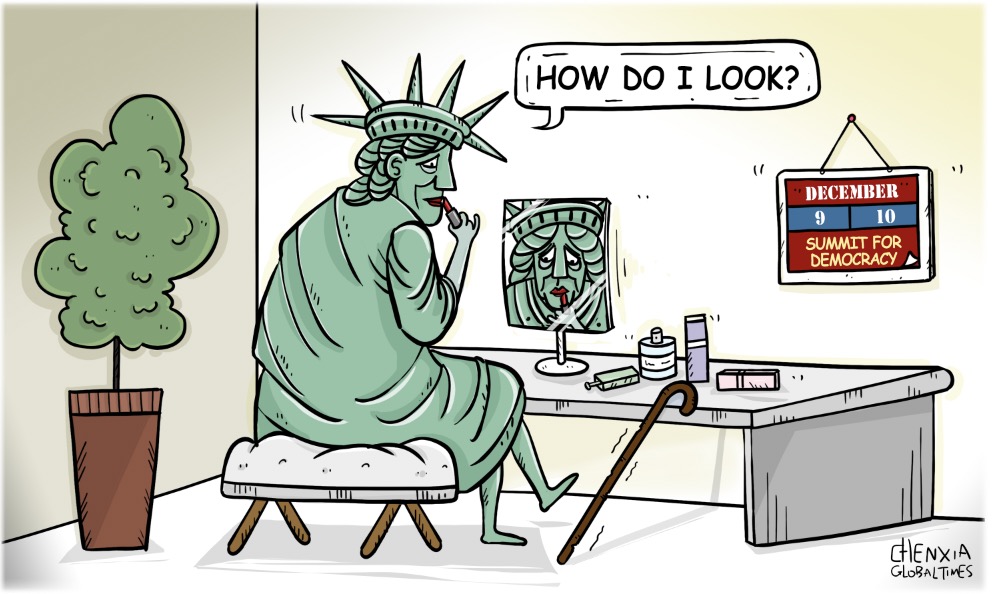
The world is undergoing rapid transformation, a reality of which nearly everyone is acutely aware, thanks in large part to the advanced technologies at our disposal that capture these shifts in real time. This has led to a palpable sense of alarm over the intensity and pace of these changes. Many current and Traditional World powers are coming to terms with a noticeable shift in global political dynamics, as control seems to be gradually eluding their grasp. This situation can be likened to the precariousness of clinging to the sharp edge of a skyscraper to prevent a fall. While this might seem like a natural progression from the viewpoint of the average citizen, from the perspective of established authorities, the scenario unfolds with far-reaching implications.

Observing that the Western bloc is experiencing a decline does not constitute an assault on its integrity, although there is justification for assaulting western integrity. Moreover, such acknowledgments have even been made by Western leaders themselves. Josep Borrell, the European Union’s chief diplomat, has starkly proclaimed that the “era of Western dominance has definitively ended.” However, my perspective is not as bleak as Mr. Borrell’s. I maintain that there is still an opportunity for Western nations to reassess their approach towards global political governance. The essence of Borrell’s argument hints at a potential solution to the swift decline of the West. He cautions against dividing the world into ‘the West against the Rest’, highlighting accusations from many in the ‘Global South of double standards.’ This insight underscores the need for a more inclusive and equitable international framework that eschews divisive narratives.

Regrettably, certain Western governments are persistently engaging in divisive tactics, particularly targeting China. The underlying motivation for such actions, despite various ‘moral’ justifications presented by the West, stems from China’s rapid ascent. A number of Western political analysts and policymakers are unwilling to coexist in a world where China assumes a leading role in political, military, cultural, and economic spheres. They position themselves as the defenders of Western ‘exceptionalism,’ yet often, their views do not reflect the sentiments of the broader populace within their nations. Nonetheless, their relentless quest for perpetual dominance and their constant fixation on the potential threats posed by China’s growth have contributed to a global environment steeped in turmoil.

The global landscape is currently fraught with challenges, from the ascendancy of gangs in Haiti and the humanitarian crisis stemming from the Gaza conflict, to ongoing hostilities in Ukraine and heightened tensions across the Middle East – including in Yemen, Syria, Iran, Iraq, and Lebanon. Additionally, unrest in the Sahel region, renewed conflicts in the Democratic Republic of the Congo, and the looming menace of climate change, seemingly present a formidable agenda for global leaders. Unfortunately, there is no clear plan or indication that all of these crises are being managed cooperatively within the United Nations framework. Instead, everyone is either choosing sides or completely turning a blind eye to these issues, with the notable exception being China which has overly sung the chorus of strategic cooperation to a disinterested crowd.

Recent reports indicate that Niger has severed military relations with the United States, following a similar disengagement from France, which has been increasingly displaced by Russia across Africa. Furthermore, Russia has been actively eroding Western influence globally, while efforts to manage Netanyahu have proven futile, and threats from Iran and North Korea are escalating. As Josep Borrell, European Union’s High Representative for Foreign Affairs noted, the Global South is reevaluating its perspective on the West, and the outlook is far from favorable. The BRICS+ continuous growth is also chipping away at Western dominance. In this context, it is imperative for Western policies to evolve, focusing on genuine promotion of Western exceptionalism of democracy without hypocrisy, moral standards without double standards, Global prosperity with active Global South participation. The West indeed needs to ‘build back better’ but this time with entirely new and different construction material because the existing system is damaged beyond repair.

Many of today’s global crises could be resolved through compromise and negotiation, particularly when the parties involved hold no malice towards each other. Indeed, simplicity often underpins the solution in such scenarios. Notably, among the world’s major powers, China stands out as the most committed to pacifism.

At present, the immediate concerns for Western nations primarily revolve around Russia and Iran. Yet, in a long-term perspective, political leaders in the West have consistently identified China as the most significant security challenge to the prevailing global order. China’s ascendancy is undeniable, and in the context of its cultural symbolism, the dragon—a figure believed in Chinese lore to govern water phenomena—serves as a metaphor for the potential impact of China’s rise on the West. Depending on the West’s approach, China’s advancement could be perceived either as beneficial rainfall or as overwhelming floods.

This raises a critical question: faced with a binary choice between relinquishing global dominance or precipitating a cataclysmic Third World War, what decision will certain Western governments make?

The Writer is a Senior Research Fellow at DWC.


Africa-China Cooperation: Dar-Es-salaam Consensus is Right Step to Building a Community of Shared Future

While describing China-Africa cooperation, Chinese officials have always argued that there are two fundamental thrust forces  to the thriving cooperation between China and Africa. The two are;  one, the Belt and Road Initiative (BRI) and two, the Forum on China-Africa Cooperation (FOCAC). The FOCAC, is also the flagship vehicle for people to people exchanges between Africa and China. China’s emphasis on people to people connections is premised in an understanding that, Amity between people is the bedrock of state-to-state cooperation which one can argue is the foundation of win-win cooperation China emphasises.

It is therefore no wonder that China has been standing at the forefront of putting people to people connection first in all its diplomatic undertakings. In line with this commitment to promote people to people connections, China and Africa have held sub forums of the FOCAC including the China-Africa peace and security forum, people forum, poverty reduction and development forum, young leaders’ forum, Think Tanks Forum, the ministerial forum on China-Africa health Cooperation, forum on China-Africa local government Cooperation and the FOCAC legal forum.

In effort to advance this agenda, in collaboration with Chinese Embassy in Tanzania, Zhejiang Provincial People’s Government, Jinhua Municipal People’s Government, Zhejiang Normal University and Unoiversity of Dar es Salaam organised the thirteenth edition of the China-Africa Think Tanks Forum (CATTF) which was held in Dar-Es-salaam under the theme; “China-Africa Practice: Building a Community with a Shared Future.”  The During  his key note address at the opening of the forum, Mr. James Mdoe the Permanent Secretary in Tanzania’s ministry of education pointed out that the goal of the forum was to  focus on exploring China-Africa cooperation mechanisms, strategic initiatives, and practical actions in the fields of industrialization, agricultural modernization, and human resources training. Moreover,  the Deputy Vice chancellor University of Dar-Es-salaam made a call for increased  Cooperation especially in the area of research across a diversity of fields adding that this would set Africa on a fast track to modernization.

The CATTF brought together more than 300 members from the Academia, Think Tanks, as well as government officials from both China and at least 49 African countries with the objective of discussing China-Africa relations in the broader global context. The thirteenth edition of the forum came up in a unified China-African voice on numerous geopolitical matters afflicting the world but most prominently Africa today in what has been termed as the “Africa-China Dar-Es-salaam Consensus.” This document was the brainchild of African and Chinese experts in which they shared insights on how to address not just the many  geopolitical challenges facing the world today but also injustices that have been suffered by Africa in the corridors of international relations.

Among other things, the forum called on the world to deepen development cooperation explaining that,  such cooperation to be beneficial to all especially the developing world, it must be built on mutual understanding, solidarity, with the goal of shared prosperity in mind.  Additionally, the consensus further made a call to all countries to endeavor to build and uphold a people centered approach to development. Ideally, “a people centered approach to development” is one that prioritizes the needs, aspirations and wellbeing of people and communities throughout the entire process of development. Such an approach must believe in ensuring that development initiatives are responsive to the concerns, values and priorities of the people and beneficiary communities. The spirit of the consensus is that only through fostering participatory development processes are we able to achieve meaningful and equitable development outcomes.  This is exactly what Africa and the rest of the global south needs; the creation of a sound institutional environment that will enable all citizens of the world to work towards a better life unimpeded.

In light of responding to the tumultuous global security landscape, the consensus urged the world to promote dialogue over conflicts. China for example has been a strong voice for negotiated solution to two of today’s major conflicts because of the understanding that the price of conflict is way to high for us to pay. In fact, the more we fan conflicts, whether it is by providing armaments for the warring parties or frustrating attempts at dialogue we are practically turning people on both sides of the conflict into Canon fodder and this can never be the blueprint for building a prosperous world.  Such is the background of the Dar-Es-salaam Consensus’s  call for dialogue over conflict. Moreover, building on the understanding that globalization must coexist in the same space with diversity,  the consensus also called for the respect of everyone’s culture, history, and traditions.  Even in a global village, people must be allowed to live and practice their culture. It is attempts to overrun or water down the culture, history and identity of people that has in some instances resulted into resistance and eventually some of the world’s bloodiest  conflicts. In fact this call is more in alignment with multilateralism over hegemony as a path to  global peace and harmony.

Furthermore, the imposition of a prearranged pathway to modernization was referenced as a major challenge that the south has struggled with for decades because what has worked for one country may not necessarily work for the next. Thus in response to this divergence between development aspirations and strategies, the Dar-Es-salaam Consensus called for giving countries a chance to pursue their own path to modernization. These are paths that take into account their culture, history,  traditions, and are tailored to their unique development needs. Accordingly, the Dar-Es-salaam consensus called for strengthening global economic governance and pushed for reforms in the global financial systems in order to create an environment where all nations of the world big or small, developed or developing will be able to thrive and to reach the universal goal of shared prosperity.

The output of the 13th CATTF therefore is a document that seeks redress or at least limit the chance that Africa will suffer the same injustices that the continent has suffered over and over again in the space of International Relations. The Dar-Es-salaam  Consensus is the tool that has been used to communicate this position and  call the rest of the world to cease trying to take advantage of Africa in order to build sustainable development bonds with Africa and the global south.

George Musiime is a Research Fellow at The Development Watch Centre.