China’s Appointment of a Special Envoy for the Horn of Africa Will Spur Region’s Social-Economic Development

During his visit to Africa earlier this year, China’s top diplomat Wang Yi proposed the Outlook on Peace and Development in the Horn of Africa (HoA) with focus on three major points; security, governance and development. To realise this, China appointed ambassador Xue Bing, a senior diplomat with experience in both developed and developing countries as China’s Special Envoy for the HoA.

Since his appointment, Ambassador Xue has visited and held consultative meetings with officials in number of countries including Eritrea, Somalia, Ethiopia, Djibouti, Kenya and he’s currently in Uganda where he has held talks with State minister for Foreign Affairs, Henry Okello Oryemu. He is also scheduled to visit South Sudan.

After his meeting with Uganda’s foreign ministry official, Ambassador Xue told journalists that as a special envoy for the HoA, his role in region will be guided by three major pillars namely; strengthening intra-regional dialogue to overcome security challenges; acceleration of regional revitalization to overcome development challenges; and exploring effective ways to overcome governance challenges.

If critically analysed, China’s appointment of a special envoy specifically for the HoA is likely to benefit the region in many and important ways. Firstly, the region is faced with challenges like like security in South Sudan, Somalia and the Tigray question in Ethiopia. Considering the fact that China’s Foreign Policy has long been non-interference in internal affairs of sovereign countries, China’s role in ensuring peace in the region cannot be underestimated. It comes in as a brotherly country, not to give lectures but on equal footing and to listen while emphasizing dialogue and advise where possible but most importantly, leaving concerned parties to decide their future.

The second pillar – acceleration of regional revitalization to overcome development challenges will help the region to get back on track of accelerated development after Covid-19 pandemic severely impacted the region. Before Covid-19 pandemic, African economies like Ethiopia and Kenya both in the HoA were projected to grow faster upwards. However, with the effects of Covid-19 pandemic on world economies, in 2020, the region’s DGP according to African Development Bank, fell by 3.4% which is about 7% if compared with pre-pandemic estimates. To rebound from this decline, African countries need investments and meaningful development cooperation from trusted allies. With China-Africa cooperation characterised by mutual benefits and mutual respect, there is no doubt the China’s special envoy for HoA will play a positive role by working with countries within the region to accelerate development agenda that mutually benefit the two sides.

The HoA has already seen tangible results from Sino-Africa cooperation. A recent study by the Africa Policy Institute found that since the launch of China’s Belt and Road Initiative (BRI) in 2013, Beijing has supported modern infrastructure projects in the HoA region contributing to thousands of employment opportunities and other multiplier effects. The report cites examples from Kenya showing positive impact of Kenya’s China built 670-kilometer modern Standard Gauge Railway (SGR) connecting Mombasa and Kenya’s inland port of Naivasha. The report also highlights China built Ethiopia-Djibouti standard gauge railway that connects landlocked Ethiopia to Djibouti port crediting it for improving transport in the region. The 752.7-km railway line constructed under China’s BRI recorded over 86.13 million U.S. dollars in revenue in 2021, which is up 37.5% compared to 2020 revenue collections, according to the Africa Policy Institute study.

Relatedly, China is arguably the only developing country that managed to end extreme poverty well ahead of UN’s target timeframe. Poverty and famine remain a major problem in the HoA with many people in countries like Somalia and Ethiopia struggling to find a single meal a day.  In Somalia for example, experts are warning that more than 3.2 million people are at risk of severe famine due to severe successive drought and poverty. “Drought in Somalia is worsening, with millions of people facing threat of famine. The situation is exacerbated by high level of poverty…,” notes a Seattle based relief and development organisation World Concern. Aware that African countries including those in the horn of Africa are still battling social challenges like extreme poverty and hanger, the HoA region can use this opportunity to learn from China’s practical successful interventions that saw Beijing succeeding in ending extreme poverty thereby lifting the country’s millions of poor from living miserable life.

As noted by ambassador Xue in his address to Ugandan media, “the HoA of Africa sits on an important location, with a large population and huge development potential. Regional peace and stability are of great significance to the peace, stability, development and prosperity of the entire Africa.”  With China’s philosophy of building a community with a shared future for mankind, one can confidently argue that African countries in the HoA working closely with China will most likely address the region’s challenges.

 While some western capitals seem to conveniently misinterpret this development claiming that China’s appointment of a special envoy for the HoA is an effort by Beijing to expand its regional influence, and others branding it part of a major power game, if critically analysed, China’s intentions are pure as Beijing seeks to promote development of allies in developing countries with philosophy of building a community of a shared future for mankind. This is contrary to some western capitals, media and pundits who often look at things from the perspective of geopolitics and major power games.

Indeed, ambassador Xue told Ugandan journalists that “Africa is not an arena for major power games,” stressing that “China sincerely cares about the development of Africa, and always treats African countries with mutual respect on equal footing.”

Broadly one can conclude that China appointing a special envoy for the HoA when they already have a Director General Department for Africa affairs at Ministry of Foreign affairs can be interpreted that Beijing has high regard for the region. Despite China’s critics, China’s willingness to support developing countries to realise their full potential is not new. As Kenyan president Uhuru Kenyatta observed while launching the 27 KM Nairobi express funded by China; “Our partnership with China is one that is mutually beneficial that is based on win-win and we are very grateful to the Chinese government, to the Chinese people for the support that they continue to render not only to our country but to the rest of Africa.”

While China’s critics claim that appointment of a special envoy for the HoA is meant to grow Beijing’s regional and global influence, China has always supported developing countries in development struggles. For example, in his address to world leaders’ during the 76th United Nations General Assembly’s 76th session, Chinese president Xi Jinping presented what he described as Global Development Initiative listing six key areas to support development efforts world over as governments try to overcome effects of Covid-19 pandemic.

Also, the appointment of special envoy for the HoA is not China’s first developmental engagement in Africa. For a fact, China unequivocally supports sovereignty of developing countries that one insinuating that Beijing is using “tricks” to gain influence over the region is not just a joke but it is an insult to the long good relations between African countries and China. For example, while under colonial bondage, many African countries received support from China thereby contributing to their struggles to snap the shackles of colonial minority humiliation. In 1960s while China’s per capita GDP was less than that of Sub-Saharan Africa, China supported and southern Africa’s infrastructure with $400 million which helped in construction of the famous Tanzania-Zambia Railway (TAZARA). This is enough to conclude that for long, China’s interest has been not to develop alone but rather building a large successful community with a shared successful future.

Therefore, regional leaders in the HoA should mobilize their citizens to book a seat in China’s drives to build a community of shared future for mankind and together build a prosperous and peaceful HoA and Africa in general.

The author is Executive Director of Development Watch Centre; a foreign policy think tank.


Africa-China Relations: A Wave fostering African Development

By Tapfumanei Mukarati

If there is a continent fighting towards achieving inclusive growth and sustainable development, it is Africa and many strategies have been crafted and implemented to achieve these fundamental goals of development, one pivotal strategy that has been implemented is making partners with foreign countries and China has proved to be the best partner for Africa as the two thrive to have a mutual beneficiary relationship.

While the global north chooses to largely view Africa as continent of humanitarian intervention, security and a hub for resource extraction, China has viewed Africa from a different perspective – viewing Africa with a constructive and development-oriented view that see Africa as a strategic partner where win-win cooperation is key for sustainable growth and development as the two strive to create a community of a shared future for mankind.

The Chinese’s South to South Cooperation and non-interference foreign policy are conducive for African countries which have been struck and influenced by master-junior partnership often advanced by the west with endless lecture and instructions to African side on what constitutes good governance and development which arguably resulted in African countries taking on unfavorable programs and hence delaying social transformation and economic growth.

But with the Chinese model of partnership of partnership of equals, mutual benefits and building community of a shared future for mankind, Africa is reaping big thanks to from China-Africa cooperation especially with availability of Beijing’s sophisticated technology to African countries at a low cost and sharing their expertise in key areas China has greatly excelled such as poverty alleviation and growing of small, micro and medium –sized enterprise (SMME) development.

China’s contribution and investments in Africa vary from infrastructure, energy, manufacturing, agriculture, mining and extraction. These investments have been propelled in different African countries. For example, in Uganda as a result of such investments, Uganda has different industrial parks such as Mbale Industrial Park, which have created employment opportunities. Outside East African region, Zambia has seen China establishing the Zambia-China Economic and Trade Cooperation the first of its kind in Africa, Egypt has seen the success of the Suez Canal Economic Zone, and Uganda’s Mbale Industrial Park has proved to be one of the best agricultural products suppliers, these are just a few among many other countries in Africa that have seen and benefited from Chinese investment.

The Chinese African Human Resources Fund has been applauded for paying tuition for 10,000 African students to train in Beijing every year, this diversifies the African knowledge base in industrialization and innovation as these students come back to their countries of origin with skills that drive for a green economy and also contribute in China’s economic evolution.

African countries have also placed themselves in a position where they can attract the Chinese investment and South Africa is on the lead in attracting Chinese investment, as it ended year 2020 with approximately USD6.5 billion foreign direct investment from China a fraction of 13.7% Chinese investment in Africa.

In southern part of Africa, Chinese enterprises have brought tremendous development in South Africa, Huawei has engaged in constructing Africa’s first standalone 5g commercial network in South Africa. In the world where the infamous global village is now the sphere where everyone is, the need for fast networks is undeniably very pivotal in ensuring that Africa is connected to the world and appreciates and endorse technological innovation, this is what the 5g network seek to enhancing in South Africa. Thus, it can be said without doubt that China is spreading new technologies in Africa.

The Chinese investments have improved the health facilities and services in South Africa. China’s Weapon Group established Anglorand Medical Pty Ltd it acquired Elite Surgical and Tecmed Africa. Elite Surgical have great capabilities in making implantable medical orthopedic devices with fundamental research and development capabilities, whilst Tecmed Africa focuses on turnkey projects in hospital construction and development, including procurements, hospital equipment design and maintenance. They further teach doctors hospital technical skills. This has helped South Africa to give effective health care to their patients which is a major development that cannot be ignored.

China has made investments that have created employment and most importantly they have played a role is fostering gender equality. China’s Jidong Development Group’s joint investment with Mamba Cement an enterprise owned by black women only has seen black women being part of a modern movement of technology. The company is the only cement plant that applies cogeneration technology and this tech reduces the use of industrial coal, this is healthy for the air and the plant generates 33 million kilowatt-hours of annually.

It is the leading plant in emissions reduction, noise control, sewage treatment and safety protection.

In health sector, many countries in Africa including Uganda, Kenya, Zimbabwe, Ghana, Kenya, and Senegal among others received COVID 19 vaccine from China this was a good gesture of strong relations between the two and the fight against the pandemic was a critical and is still critical and China has supported Africa without boundaries.

The China Africa relations have also resulted in the out spill of new technology in African communities that the Chinese enterprises will be operating from, and this gradually makes the societies appreciate technology and desire to own their own new technologies, thus it has motivated the founding of Innovation Hubs that specialize in making better technologies for the future.

African Union’s Agenda 2063 that seeks achieve sustainable development and promote inclusive growth that benefits more people, is achievable as Chinese investors have effectively engaged with Africa and their investments play a greater role in achieving inclusive economic growth and a community of a shared future for mankind.

China is a wave fostering development through making consistent and practical contributions, and these contributions have a positive influence on the economy and social development in the host countries.

It is vital for both Africa and China to keep their ties strong as they both stand to achieve their goals as long as they are together, and this relationship can stay strong when green deals are made.

The writer is a research fellow with Development Watch Centre; a foreign policy think tank.


Sino-Africa Relations and USA’s Compete Act: US Should Emulate China’s Principle of Mutual Respect.

By Allawi Ssemanda and Alan Collins Mpewo.

Last week, the United States of America (US) House of Representatives passed an act introducing strong measures to counter what they described as China’s growing relations with African Countries. In the Act entitled “America Competes Act of 2022,” US law makers passed six sections all seeking to counter or undermine China-Africa relations. The subtitle of the Act is also telling: “America Creating Opportunities for Manufacturing, Pre-Eminence, in Technology, and Economic Strength (America Competes) Act of 2022.”  If implemented, this act will see US using Africa based Civil Society organisations, US Global Media Agencies, organisations like Young African Leaders Initiative, USAID, and Mandela Washington Fellowship among others to undermine China’s development cooperation with Africa while promoting US’ primarily to promote Washington’s “Strategic interests in Africa.”

All the above should make us pause some questions such as; where does America Competes Act of 2022 leave African countries’ ambitious infrastructure and other developmental projects?  Is this Act meant to promote African countries interests and independence or America’s? Isn’t this Act against principles of respecting sovereign states legitime interests?

If critically analysed, America Competes Act of 2022 has no interest in promoting Africa’s interests or goals. The Act’s main focus is to weaken China-Africa cooperation and promote US’ “strategic interests” on the continent. Put differently, the Act is meant to help Washington revive its dying hegemony in Africa. The unfortunate part with this is that, it is not the US to miss out but Africa.

For example, section 30271 of America Competes Act of 2022 shows that its main objective is not helping African countries but rather to know how China’s projects and cooperation with African countries is impacting “US’ strategic interests.” The Act directs US secretary of state to submit a report which will guide Congress to counter Sino-Africa cooperation.

Further, section 30276 recommended amendment of “the Electrify Africa Act of 2015 by expanding the statement of U.S policy to include advancing U.S foreign policy.” In other words, US’ house of Representatives wants US’ Electrify Africa Act of 2015 amended to include provisions that promote US’ foreign policy interests in Africa at the expense of African countries. Further, the same section talks of encouraging export of US energy resources that benefits US’ interests stating that the US is committed to helping facilitate the export of U.S. energy resources, technology, and expertise to global markets in a way that benefits the energy security of U.S.”

While it is true that all countries world over act in their own interests, aware that relationship between China and African countries are guided by China’s philosophy of mutual respect and working for a shared future, one can confidently say US’ Competes Act of 2022 whose intent is undermining Sino-Africa relations in favor of Washington’s strategic interests will largely affect African countries whose partnership with China has been praised for addressing Africa’s challenges especially infrastructure sector.

For example, the action plan for the year 2022-2024 produced from November 2021 Forum on China-Africa Co-operation (FOCAC) ministerial conference held Senegal, China renewed her commitment to continue supporting African countries development efforts. Indeed, this Action Plan details how China and African countries will co-operate in the next three years with clear details of projects to be supported through a generated consensus which reflects China’s relationship with African countries – mutual respect and the partnership of equals unlike US’ America Competes Act of 2022 passed by American law makers with no single input of African countries.

 While FOCAC’s 2022-2024 action plan offered a package of $40 billion financial commitments of which $10 billion will be invested in specific sectors, namely; manufacturing industries, agriculture and digital economy which is a big step in empowering African countries and creating China-Africa Community with a shared future, section 30273 of US’ Competes Act requires US president to “establish an interagency Working Group, which shall include representatives of the Department of State, the Department of Defense, the Office of the Director of National Intelligence, and other agencieson means to counter Chinese” digital cooperation with Africa. Today, it is an open secret that technology is way to go and China has been building this capacity in a number of African countries Uganda inclusive. Therefore, any country that seeks to derail African countries or divert them from this as US’ Competes Act of 2022 seeks to do is an enemy of the continent.

Also, while section 30272 of US’ Competes Act of 2022 “requires that the Secretary of State, in consultation with the Secretary of the Treasury and Secretary of Commerce, the Attorney General, the U.S. Trade Representative, the USAID Administrator, and the leadership of the U.S. International Development Finance Corporation submit to Congress a report setting forth a multi-year strategy for increasing,” through FOCAC’s 2022-2024 action plan, China has already earmarked $10 of her International Monterey Fund (IMF) drawing rights share to assist development in African countries. Also earmarked is $10 billion will go to supporting trade with aim of boosting African countries exports to China a development expected to increase volume of China’s imports from African countries to a whopping $300 billion while $10 billion has been set aside to facilitate credit lines to African financial institutions to be accessed by several African countries.

If critically analysed, the entire part 4 of Subtitle D of this act does not only seek to promote US’ interests but also seeks to broadly curtail African countries choice on which country to associate with. Put differently, US house of representative meet and passed a law that will covertly decide for African countries who their development partner(s) should be! Even if Washington sugarcoats their act with diplomatic words to make it look pro-Africa, the act is largely political, seeks to expand their geopolitical calculations and in light of principle of State Sovereignty of these African countries, it is against the values of sovereign states.

On contrary, China’s relations with Africa remain bold as they are founded on a principle of mutual respect, mutual benefits and not outright imperialism or ‘ally and master’ like the West’s. It’s arguably clear that China remains resolute to respect State Autonomy and Sovereignty of her African counterparts as the two sides and the U.S should learn from that development in rethinking its mode of presence in Africa.

This principle has been greatly yielding for both China and Africa in context of mutual benefits. Trade, infrastructure, energy, to state the least have a long list of achievements that have emerged from this foundational cornerstone in the few decades China has been actively present in Africa. In fact, new participants in this yielding phenomenon on the African continent have emerged by taking examples of their counterparts, key players involved in the diplomatic relations. But now with the passing of the Competes Act of 2022 by the U.S, a question stands out! How will African countries standout by the time the U.S achieves its intended goals? Africa deserves respect of its independence. Africa deserves relations of mutual respect with whoever its countries choose to engage on the global stage of diplomacy. I think it is high time the US dropped her stance against Sino-Africa relations and join China and Africa in creating a China-US-Africa Community with a shared future and benefits. Dominance is a thing of past!

Allawi Ssemanda and Alan Collins Mpewo are research fellows at Development Watch Centre, a foreign policy think

Uganda Should Book a Front Seat in China’s Africa Digital Drive

By Moshi Israel

While addressing China-Africa Internet Development Forum, Deng Li, China’s Assistant Foreign Affairs Minister, reassured representatives of African and Chinese internet firms, government officials responsible for internet development, scholars, and technology experts of China’s commitment to creating a digital Africa.

Li’s comments, emphasizes a collaborative effort between Africa and China to transition Africa to a digital economy, and serves as a reminder to all that China is committed to Africa’s long-term development agenda. China has been promoting the concept of a digital Africa to African leaders, and it appears that some of them are taking notice. Uganda cannot afford to fall behind, and our government must increase investments in the information technology industry at a 5G-like pace.

The state of the future will be a digital state, a technologically advanced country that runs smartly on the internet of things (IOT), or simply put, computing devices connected to every object, from smart home security systems to connected appliances, ultra-high-speed internet, autonomous farming equipment, biometric cyber security scanners, wearable health monitors, and wireless inventory trackers. IOT is the future that China is selling to Africa, and Uganda must invest in it if it is to rise above poverty and even go beyond a middle-income country.

The remarks of Assistant Foreign Minister Deng li follow President Xi Jinping’s assurances that China and Africa will collaborate in new business forms such as digital economy, smart city, and 5G. President Xi made these remarks last year in his address to Forum on China-Africa Cooperation (FOCAC) where he stressed China’s vision of a Digital Africa a move that is already taking shape in some African countries.

South Africa has responded to this trend by establishing Africa’s first standalone 5G commercial network. The project is collaboration between Huawei of China and Rain (South Africa’s data-only network). Senegal has also established its National Data Centre, which has been aided by Chinese funding and technology. China has also introduced e-based platforms such as the Electronic World Trade Platform (eWPT), which is a framework aimed at making cross-border e-commerce more accessible to small and medium-sized enterprises, according to the Alibaba group (SMEs). Deng Li, Assistant Foreign Minister, also mentioned how the trade platform has brought African products to Chinese consumers.

China’s fingerprints can be found all over Africa’s digital future if one looks closely. For example, Huawei and Alibaba have launched programs such as “seeds for the future” and “Africa’s Business Heroes Competition,” which have aided in the training of young African internet experts.

Already, China’s Huawei has committed about $150million to support Uganda’s Huawei Seeds for the future programme. Through the program, Ugandan’s youth will be trained digital skills.

Uganda should be a keen observer to these trends and be ready to jump on board because by all indicators, the technology train is warming up to leave the station. As per the remarks of Mr. Deng Li, China is wasting no time and has announced that the country is ready to work with Africa to ‘formulate and implement a China-Africa Partnership Plan on Digital Innovation.’  This plan involves six important areas of focus as laid out in Mr. Deng Li’s remarks.

To summarize, the partnership will focus on growing the digital economy, strengthening digital infrastructure, promoting digital education and digital inclusion, jointly maintaining digital security and enhancing digital governance capacity, and finally developing cooperation platforms to promote digital progress through exchanges.

On the continent, Africa as a whole is already benefiting from China’s technology advancement and cooperation. In December 2000, Ethiopia launched her second satellite (ET-SMART-RSS) which was built and launched with assistance of China. Such innovations and support coupled with other plans such as China’s announced China-Africa Internet Development and Cooperation Forum.

As Bill Gates famously stated, ‘the internet is becoming the town square for tomorrow’s global village.’ As a result, Uganda’s National Development Strategy should be built on a Digital Transformation Framework, with the goal of building a digital economy that will ease and improve transportation, manufacturing, education, and provide jobs for many young people.

The writer is a junior research fellow at Development Watch Centre, a Foreign Policy Think Tank and a graduate of International Relations and Diplomacy


Chinese infrastructure loans: not debt trap but catalyst for Economic Development and Growth

Africa’s biggest challenge, especially Sub-Saharan region, is poor and aging infrastructure.  According to a recent study by McKinsey and Company, unless addressed, infrastructure deficits in key sectors such as roads and energy will continue to hinder African countries’ economic growth and development especially in Sub-Saharan Africa. The study further reveals that the region’s attempts to reduce this gap have not yielded largely due to lack of funding which leaves many planned infrastructure projects stuck at planning stages: “80% of infrastructure projects fail at the feasibility and business-planning stages,” a phenomenon the study branded “Africa’s infrastructure paradox,” stressing that despite high demand for infrastructure funding, there are few partners or investors willing to provided huge amounts needed for such projects.

Limited funding for important projects at a time when the continent has severely been impacted by the Covid-19 pandemic, the continent has less options to make an economic rebound. In 2020, the region’s DGP according to African Development Bank, fell by 3.4% which is about 7% if compared with pre-pandemic estimates.

To recover from this pandemic induced recess, African countries must include more funds in infrastructure development for any stimulus plan the continent is thinking of.  Sectors such as roads, energy, and information communications technology must be given priority for they can stimulate economic performance through supporting creation of jobs, boosting supply chain and trade. It is only through funding and investing in infrastructure that our much-hyped Africa Continental Free Trade Area will realise its anticipated goals.

It is important to note that while African countries need to close infrastructure funding gaps, Official Development Assistance (ODA) and the so-called traditional funders continue to decline. While this decline may be attributed to budget constraints in Western capitals, we cannot ignore factors like liberal market ideology that in the end makes livelihood projects a more likely beneficiary of ODA. This leaves Africa’s much needed infrastructure projects with little attention. Aware that infrastructure projects require big amounts of money and there are high risks involved, ODA providers are steadily pulling out their funding while commercial institutions consider these projects a no-go area given the risks.

On the other hand, over the last two decades, China has been providing bilateral loans to almost all African countries to cover their infrastructure funding deficits through commercial and policy loans. Arguably, such funding is vital in supporting growing of African countries economies, industrialization and employment opportunities.

Though often criticised by some western capitals branding China’s funding as “debt trap,” it is very clear that China’s funding goes beyond West’s binary aid model of “government versus markets” for it has helped reduce funding gaps and revolutionised the concept of funding developing countries’ projects on basis of mutual benefits and “equal partnerships.” This is a complete paradigm shift from where funders would dictate on how a receiving country should use availed loan.

While China seems ready to offer a hand to African countries to improve their infrastructure sector, some African countries seem swamped in what one may call western media narrative and opinion. This narrative is mainly pushed for geopolitical reasons or the need, by the west to maintain their influence over African countries. This eventually drifts the continent into unfounded old frameworks and colonial motifs. It is the fear of their wanning influence that   drive western pundits to claim, warn and make all sorts of allegations that China has hidden interests in Africa. The other example is West’s misinterpretation of Beijing’s support to African as a new ‘Scramble for Africa,’ claiming that Africa is falling victim once more to an outside global power. Maybe we should ask ourselves, why does the West brand Chinese development assistance and loans to Africa as “debt trap” and “debt diplomacy” and their own loans and assistance to Africa is considered ‘good loan(s)?’

Another example that seems illogical is Sino-Africa sceptics’ uncritical branding of China’s funding and developmental loans to Africa as “debt trap” and “debt diplomacy” which is arguably meant to undermine Sino-Africa relations and present it in a negative form. Another intriguing example is U.S.A’s former Assistant Secretary of State for Africa, Tibor Peter Nagy who on 5th October 2021 cautioned African countries to be worry about China, branding Beijing a bully by tweeting:  “China’s aggressive flying aircraft over Taiwan should be an alarm for Africa. Country Bullies are more dangerous than people bullies. Beware of their hegemonistic arrogance. Africa is 21st century’s treasure house – and should benefit Africans.” When critically analysed, one can confidently conclude that Nagy’s tweet was simply political. While heading African affairs at the State department, President Trump called African countries “s*t holes” and Nagy did not apologise to Africans neither did he resign for such disrespect, but is the same person trying to lecture Africans who they should trust!

While it is important that African countries must not take debts and loans beyond their capacity, there is nothing wrong with taking loans to support infrastructure development. As Bent Flyvbjerg, a Danish professor at Harvard University once noted; “Infrastructure is the great space shrinker, and power, wealth and status increasingly belong to those who know how to shrink space, or know how to benefit from space being shrunk.

Therefore, criticizing African countries like Uganda for taking Chinese loans to improve our infrastructure is unwise and broadly selfish. As J.P Morgan taught us, “a man always has two reasons for doing anything: A good reason and the real reason.” In Uganda’s case and other African countries’, seeking infrastructure loans the two reasons are simple – it is to shrink all our linkages and supporting other factors of production that comes with good infrastructure.

Actually, taking loans has never been bad provided debtor countries are “responsible” borrowers and meet their obligations of paying back. It is ironical that Countries which have taken over 60 years to pay their loan which helped them to take off are the ones accusing African countries of taking developmental loans. For example, it took United Kingdom 61 years to pay its loan $4.34 billion the country borrowed from the U.S and Canada in 1945. Some analysts argue it is this loan that saved U.K from financial crisis shortly after the second world war.

In conclusion, African countries should use the opportunity of China’s willingness to offer financial support to improve their infrastructure for it is one of the sure ways they will unlock their potential. The good thing is that Beijing has always been kind enough on many occasions agreeing to do debt restructuring. Also, African countries, Uganda inclusive, can invest more in infrastructure. The other sure way African countries can ensure payment of loans is through asset recycling. This enables authorities to reuse capital invested in strategic and profitable infrastructure assets like fibre optic networks, road tolls, airports and power plants. Under this arrangement, such assets can be offered to private sector investors under concession model but ensure private sector does not over exploit citizens using them.

Allawi Ssemanda is a research Fellow with Development Watch Centre, a Foreign Policy Think Tank.


China-Africa Relations: What to expect in 2022 and beyond.

The year 2021 ended on a very good note for African countries in context of Sino-Africa relations with Beijing showing readiness and commitment to double down its development support and cooperation to African countries.

Looking at Action Plan for the year 2022-2024 produced from November 2021 Forum on China-Africa Co-operation (FOCAC) ministerial conference held Senegal, it is clear that China is ready to increase its development support to African countries. One can also confidently argue that this Action Plan which details how China and African countries will co-operate in the next three years will highly succeed considering the fact that it was generated through consensus which reflects China’s relationship with African countries – mutual respect and the partnership of equals!

The nine areas identified in this action plan namely; peace and security, digital innovation, promotion of trade, people-to-people relations, promotion of investments in African countries, supporting medical and health programs, poverty reduction, supporting agricultural programs, green development, and capacity building are all key to African countries economic and sustainable development.

Despite striking similarities in some sections of 2018-2021 action plan, the 2022-24 action plan has packages that if well implemented will spur economic, social and sustainable development.

For example, the 2022-2024 action plan has a package of $40 billion financial commitments of which $10 billion will be invested in specific sectors, namely; manufacturing industries, agriculture and digital economy. Aware that the 2018-2021 action plan did not specify which sectors would benefit, this time workplan singles out sectors to benefit from China’s partnership.

Also, in this workplan, Beijing earmarked $10 of her International Monterey Fund (IMF) drawing rights share to assist development in African countries, $10 billion will go to supporting trade with aim of boosting African countries exports to China a development expected to increase volume of China’s imports from African countries to a whopping $300 billion while $10 billion has been set aside to facilitate credit lines to African financial institutions to be accessed by several African countries.

Considering effects of covid-19 pandemic on global economy which saw major economies growth reduce with China’s growing at 2.3% in 2020 which is the lowest since 1976, China committing $40bn to African countries is evidence of China’s commitment to support her allies.

Fighting Covid-19 Pandemic Together.

The 2021 FOCAC ministerial came at a time when the world is battling Covid-19 – the worst pandemic of our times which has devastated the world for two years and its defeat remains elusive, with over 326-million people infected, and claimed lives of over 5.54 million people.

In all this uncertainty, using their financial muscle, Western Countries chose vaccine nationalism-buying almost all produced vaccines on markets, and leaving poor and developing countries especially in Africa with less no vaccines, putting the continent far from the needed 60% vaccination for its population needed for herd immunity. Even with Covax facility, today, only 14% of African countries have vaccinated their citizens, 76% in Canada and the U.S.A, 66% in Europe, 72% Asian Pacific, 72% Latin America and 51% in Middle East.

However, as developed countries hoarded vaccines, working with African countries, China organized a novel extraordinary China-Africa summit to devise means of containing the pandemic. Consequently, China and African countries have been working together in fighting the pandemic by donating thousands of tonnes of materials required in fighting covid-19 which include facemasks, ventilators, testing kits, ventilators, financial assistance and sending experts to work with African counterparts among others. China has also worked with some African countries like Morocco and Egypt to locally produce Covid-19 vaccines.

Addressing the 2021 FOCAC ministerial conference, President Xi Jinping announced China will supply one billion vaccines to African countries of which 600 million will come as donations while 400 million doses will be produced locally through joint vaccine production arrangement between China and African countries. It is important to note that Morocco have already started producing vaccines with support from a Chinse pharmaceutical firm Sinopharm. President Xi’s promised 1 billion vaccines to Africa is enough to vaccinate 40% of continent’s population which will be a big boost. If fully implemented, this will be the largest bilateral vaccine support to African countries if compared with U.S.A’s. 500million vaccine pledges promised to poor and developing countries world over.

While China’s critics accuse Beijing of the so-called Vaccine Diplomacy, arguably, to compare China’s assistance to African countries in building a functioning health system with politics is an insult to Africans and ignorance of facts like African countries’ need in building a robust public health system that will be able to withstand any future pandemics. This is what China is doing. The construction of the Headquarters Building Phase I Project of the Africa Centers for Disease Control and Prevention (Africa CDC) funded by China is ongoing in Addis Ababa, Ethiopia.

Revolutionizing digital economy and green development

The 2022-2024 action plan for China-Africa cooperation also points at digital and green economy. To show emphasis, digital economy is presented as an independent subsection under economic cooperation and green development is presented in its section signifying China’s commitment to support African countries in the two sectors.

Aware that digital revolution is the way to go, China and African countries have come up an initiative to work together and jointly build a China-Africa Community with a shared future in Cyberspace, a development that will see both sides working together in areas like artificial intelligence, big data internet, mobile internet, cloud computing, among others. In Uganda for example, Huawei is already implementing this program and hence, supporting African countries technological transfer, digital infrastructure and digital innovation.

In green development, focus is given to ecological and climate change mitigation which can be achieved through clean energy which China is supporting in Africa. This initiative is spot-on for one can argue that it directly responds to China’s critics who often claim that China does not consider environmental issues when supporting developmental projects in Africa.

All in all, China-Africa cooperation if measured from the success of FOCAC, in its 21 years, the cooperation has achieved a lot for the African countries and much more is in pipeline! Going by commitments released by Chinese government in its FOCAC whitepaper of November 26th 2021, China is ready to double down her support to African countries to realise a China-Africa Community with a shared future. From 2022-2024, FOCAC’s focus will be on cooperation like digital economy, health, poverty reduction, green development, capacity building, peace and security, promotion of trade, among others. One can therefore confidently argue that China is and continue to be Africa’s desired development partner.

However, African countries should not just sit and wait to be spoon-fed, they must be pro-active and use the opportunity of China’s willingness to work with them as “equal partners” so as to further gain from Beijing. As of today, despite having FOCAC in place, there seems not to be a coordinated engagement with China with no single African country having a clear “China strategy.”  As of today, China has released comprehensive three Africa policy papers since 2006 yet, despite having many experts on China including thousands with highest education thanks to Chinese government scholarships, there no single policy paper on China has been developed by Africa as a continent either under the African Union or even FOCAC.


Allawi Ssemanda is a senior research fellow at the Development Watch Centre.

China-Africa cooperation is a win-win partnership: Debt Trap talk is Western propaganda

“If you tell a lie big enough and keep on repeating it, people will eventually come to believe it,” Nazi propaganda minister Joseph Goebbels once noted. If you have been following current international affairs, you would have noticed that most of Western international commentators are arguably obsessed with China-Africa relations, especially when commenting on the thousands of China-funded or supported development projects in Africa. Despite clear and countless opportunities, born out from China-Africa relations, and backed by international scholars, experts and organizations, politicians and some commentators from the West continue to frame Sino-Africa relations, with many branding China’s development assistance as a “debt trap” and others calling it “debt diplomacy.”

Interestingly, despite many developed countries, such as the U.S, UK and almost all members of the Organization for Economic Co-operation and Development (OECD), having arrangements where they support development projects in African countries through loans, only development assistance from China to African countries is branded as a “debt trap.” Perhaps it is high time someone questioned those promoting the debt trap and debt diplomacy idea and called it what it is – Western propaganda tact whenever reporting about China-funded projects in Uganda and Africa in general.

It is not surprising that many international relations scholars and analysts branded as “bad journalism”, reflecting “poor understanding” of international contractual law, a report which suggested Uganda was set lose its international airport to China. While this was a spot-on characterization of such reporting, one can still argue that it fell short of addressing the purpose of such reporting fact such reporting, which, in my view, is to undermine great achievements African countries, Uganda inclusive, have realized as a result of mutually beneficial relations with China.


As Indira Gandhi taught us, questioning is the basis of all knowing; and those who don’t question are condemned to bondage. Possibly, African countries should ask: what are the motives of “debt trap” propaganda? Is it because its proponents love African countries so much that they are concerned that African countries will fall into these so-called traps? Why is it that infrastructure funding from Western countries, coming with conditions, is called development assistance while China’s condition-free assistance is branded a “debt trap”?

In my view, those promoting the so-called Chinese debt trap are hypocrites who have been grossly unfair not just to Africa but to the entire global south, for decades now. Despite knowing the importance of improved infrastructure in social and economic development, the West, unlike China, has for long been giving developing countries very limited support for the improvement of infrastructure, transport, and electricity, which are key for sustainable development. Moreover, even infrastructure support from the Paris Club and individual Western countries has been declining steadily for some time now. While on the surface the decline in funding to African countries is just a manifestation of budget constraints facing Western countries, a deeper analysis reveals that this decline is also due to the so-called liberal market ideology practiced by the West.

In addition, a critical analysis of the modus operandi of colonialists and imperialists reveals that they have never wished to see Africa liberated. That is why, for the West, it is a disaster when China offers mutually beneficial assistance to African countries, because such assistance will eventually make African countries more self-reliant, which is directly against the hegemonic aspirations of some western countries. This largely explains why Western commentators have coined frightening phrases, such as “debt trap” and “debt diplomacy” to scare African countries into abandoning their relations with Beijing.

Actually, western countries are worried that, as a result of win-win Sino-African cooperation, China is wining the hearts of African countries, essentially because Beijing respects African countries, and is happy when they all prosper. On the other hand, Washington’s relationships with African countries are premised on Washington’s desire to dictate how her African partners should run their affairs. In other words, in its foreign policy, the U.S seeks to outrightly exert its hegemony over African countries.

In his Opinion entitled Why America Must Lead Again, President Biden is very categorical. The guiding principle of his foreign policy is to place the USA at the head of the table, and selfishly govern the world.  Indeed, as argued by Walter A. McDougall, a professor of History and International Relations at the University of Pennsylvania, in his article, “Can the United States Do Grand Strategy?”, USA foreign policy has always been guided by imperialistic and selfish interests; “The real motive for USA foreign policy during all eras of history was not security or liberty, but the capitalist appetite for new markets, resources, and customers, at home and increasingly abroad. So, the American Dream was real, but therein lay tragedy because in order to meet the growing expectations of a growing population, the United States was ineluctably drawn to imperialism that belied its liberationist rhetoric.

It is, therefore, clear that the USA has never sought to establish a partnership with another country if that partnership undermines the total hold of the USA on that country.  To the west, seeing China building the capacity of African countries to end their dependency is a night mare. It is what John Mearsheimer calls the tragedy of great power politics. Therefore, as the USA and her allies brand China-Africa partnership a debt trap or debt diplomacy, African countries should know that, in context of sustainable development, the USA is not, and will never be, the best partner.

Actually, unlike Sino-Africa relations, the partnership between the Global North and the Global South has always represented the true meaning of a debt trap! The West’s development assistance and aid to the Global South, especially in Africa, has always been characterized by confidentialities, which are often incompatible with African countries. Whereas some scholars argue that partnership should involve a degree of equality among players, the West’s cooperation and is premised on Western hegemony; and the sstructural adjustment programs (SAPs) were a perfect illustration of this.

For decades, the Global North extended development assistance through the World Bank and IMF and their conditional assistance sometimes included telling African countries which sector to prioritize, the number of workers to retrench, and basically how governments should run, at times pouring funds into historical black holes, like political administration, which are riddled with corruption and bureaucracy. Broadly, one can argue that such forced priorities are tantamount to a debt trap as many of African countries stopped investing in domestic priorities in favour of what the World Bank and IMF agents dictated regardless of what African countries needed to take off economically.

With such facts known but ignored, and the continuous framing of China-Arica relations, one cannot help but conclude that branding China’s development assistance to African countries debt trap or debt diplomacy is propaganda based on selfish political interests of the west.

Allawi Ssemanda is Executive Director Development Watch Centre Think Tank, and Ndawula Shemei is a research fellow at the Centre.


Symposium on Western Democracy in Africa

Today 10th December, His Excellency Chen Huixin, the Deputy Chief of Mission, Chinese Embassy in Uganda gave a key note address during a Democracy Symposium organised by Kampala International University and Uganda Council on Foreign Relations under the theme “Dissecting Western Democracy in Africa.” Below is H.E Chen Huixin’s speech;

Protocol observed,

Ladies and gentlemen,

Good afternoon! It gives me great pleasure to attend the Democracy Symposium organised by KIU and UCFR, on behalf of the H.E. Zhang Lizhong, Chinese Ambassador to Uganda. I wish to make some remarks as follows:

First, democracy could be and should be realised in multiple ways. We in China often say that “language dialects change every ten miles, and folk customs differ every 100 miles”. On the African continent, there are many different features – rich savanna in the east, broad desert in the north and dense jungle in the west and centre. Different soils produce different crops and cultures. And that is also true with the diverse world with so many countries. As the saying goes that “personality is shaped by the environment”, democracy should also be moulded by the conditions on the ground. No two leaves in the world are completely the same. Likewise, a one-size-fits-all model of democracy for the whole world does not exist, and there is no democratic system that can claim to be perfect or superior to others.

When dissecting Western democracies and interventions in Africa, it is not difficult for one to draw the conclusion that: imposed democracy does not work, and African countries should not be lectured about how to build their own democracy. In other words, for democracy to succeed in a country, it must take deep roots in that country, and make its own people happy and satisfied. If you look at the world, be it in Afghanistan, Libya or Iraq, democracy imposed through color revolutions all ended in catastrophe. And at the end of the day, it is the innocent people that bear the brunt and suffer.

Second, as for which country’s democracy is good or bad, people living in that country have a natural feeling and say. Therefore, a basic criterion of democracy should be about the people, i.e., whether the people have the right to govern their country, whether their needs are met, and whether they have a sense of fulfilment and happiness. If the people are only awakened when casting their votes and sent back to hibernation when the voting is over, if they are served with sweet-sounding slogans in campaigns but have no say after the election, if they are wooed during canvassing but left out in the cold after that, this is not a genuine democracy.

On who has the right to define democracy, I find that there are a lot of similarities between China and Uganda. For example, in his speech at the swearing-in ceremony earlier this year, H.E. President Museveni said, “It is quite comic to hear of some actors in the world, giving us lectures about democracy! We designed this system, not from air-conditioned rooms, but from the jungles of our country where we lived with the people for much of the 16 years of the Resistance (1971-1986).”

Third, democracy is a shared value of all human beings and a critical philosophy that the Communist Party of China has unswervingly upheld. The Party always stays committed to the path of socialist political advancement with Chinese characteristics, works to ensure that the Party’s leadership, the people’s position as masters of the country and law-based governance form an indivisible whole, and firmly opposed the delusion of some political thoughts in Western countries including what they call the power rotation among multiple political parties, thus embarking on a democratic path of developing whole-process people’s democracy.

China’s whole-process people’s democracy is a complete institutional chain, including electoral democracy, consultative democracy, social democracy, primary-level democracy, citizen democracy, and all other elements of democratic politics. It covers democratic elections, democratic consultation, democratic decision-making, democratic management, democratic supervision, and all other fields of the democratic process. It is not only based on a complete institutional procedure but also full participation and practice. It is a democracy in terms of process and outcome. It achieves the integration of procedural and substantive democracy, and direct and indirect democracy. It is people’s democracy and at the same time represents the will of the state. As a result, the Chinese people have strong confidence in their political system. And the fundamental reason is that China’s whole-process people’s democracy is highly democratic in terms of both quantity and quality, and is sincerely welcomed by the Chinese people. This is the true democracy of the people.

By reviewing the gains and losses of political development at home and abroad, the Party keenly realised that China’s political civilisation and political system are deeply rooted in China’s society and soil. It will not work for China, or Uganda or other countries for that matter, to copy the political systems of other countries, what’s worse, it may even ruin the country’s future.

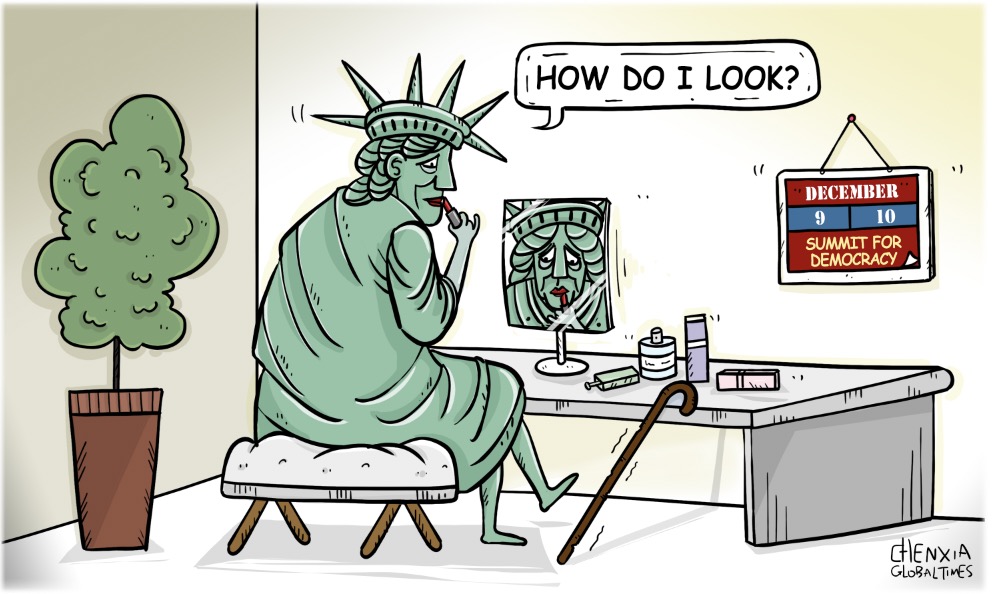
Fourth, our world is going through a pandemic and changes unseen in a century. Humanity faces unprecedented risks and challenges. Now more than ever, the world needs to come together and respond collectively. However, a certain country is putting together the so-called Democracy Summit as self-styled leader of democracy. It divides countries into different levels of a hierarchy, labels them as democratic or undemocratic, and points fingers at other countries’ democratic systems. This actually reveals the hostile mindsets and intentions of some Western countries, namely, democracy is just a tool to repress anyone who disagrees with them and to contain the development of other countries. It is in itself, not democratic at all.

Last but far from the least, in order to safeguard fairness and justice, and promote democracy in international relations, China is willing to work with the international community, including Uganda, so that people of all countries can truly enjoy broader and more substantial rights and freedom.

Thank you!


Creating a functioning health system for all: Lessons from China.

By Joseph Nyero

A heath system comprises all organisations, institutions and resources that produce actions whose purpose is to achieve good health. Its building blocks include; governance, human resource, health information, health finance, service delivery, medicines, vaccines and appropriate technology.

All these components work together interrelatedly with an intrinsic goal of providing good health. A breach in one of them make lead to the collapse of the whole system. Take for instance, if there is not health finance, the medicine will not be bought and the service delivery will be poor. It is therefore vital to develop the system as a whole and to do a full systems analysis if there is need to fix any problems in a health system.

Several studies have confirmed that having well-functioning health systems is a forward in eliminating unnecessary and controllable deaths.

While it is not like a picnic to build a strong and good health system, we can borrow a leaf from some of developing countries that have succeeded in this aspect.  China for example had its first health system reform in 1996. The effectiveness and efficiency of the reform was questioned after a couple of years because people still had the same problems, they had in the first place.

They still had high out of the pocket expenditure, most of them didn’t have health insurance. A large proportion of the people couldn’t afford the health that they needed. In a closer look, these are almost the same problems faced by the health system in developing countries like Uganda.

People at times have to sell off their assets just to afford medical care which pushes them right to poverty even if they had escaped the poverty line. It is important that we look not only at prescription drugs but also make sure that health care is a major focus.

Following a failure from a top research institute, the former reform of 1996 had failed. China then embarked on planning another reform in 2007 where they consulted and worked with very many of their ministries. In 2009, the central committee of the communist party of china issued a policy. Its major aim was universal health coverage by 2020 through strengthening health care delivery, health security and provision of essential medicines. This policy reform is a long-term endeavor but the returns are worth the investments. Even when it is quite challenging for the African setting, we ought to start on our own reforms. Like the Chinese say, a journey of 1000 miles starts with a single step.

In order to get the job done, the state council set up a state council health systems reform office where the activities of the reform would be coordinated. The following were the policy reforms.

Under social health security, the social health insurance package was extended, medical aid was extended to the eligible poor and those with catastrophic medical expenditure.

The payment system was also reformed. Through this, 95% of the population has been covered by health insurance schemes by the end of 2017 and catastrophic health insurance introduced in all provinces.

Such a system in Uganda would reduce the burden of out of the pocket health expenditure. Often a times I have seen families who just take their patients back home because they can’t afford any more bills.

These people die from cases that could have been well managed if they had some form of insurance. Such a policy in Uganda would thus reduce mortality.

For the essential drugs, the new policy promoted rational use of antibiotics, removing price mark ups of drug and reforming the drug procurement system. This decreased the unnecessary use of anti-biotics and also made the drugs more accessible to the public. One of the issues in Uganda is over use of antibiotics which will eventually lead to resistance.

It bothers me a lot when I see how a wonder drug like ceftriaxone is used in cases where a milder antibiotic would work just fine. Antibiotic resistance is real and a day can come when a drug that did magic can no longer do a thing. A good example is penicillin. When it was discovered in 1928, it greatly improved mortality. Right now, bugs can have it for lunch! Such a policy in Uganda would not only reduce unnecessary bills on antibiotics but also delay the incidence of resistance.

As a doctor, sometimes I have had to walk through the pharmacies in Kampala to determine their prices. This is because I know that’s the first question patients ask upon presenting to them the treatment options. And from the search, the prices are shockingly different. I then send my patients to the cheapest pharmacy for the respective drugs. If we had a policy like the one China put up where the prices are controlled, medical care would be cheaper.

People even opt for traditional medicine that ends up messing their livers and kidneys the more. This is worse if the patient presented with a liver or kidney failure and they add on herbs to the problem. The people actually don’t want the herbs, they just can’t afford the modern medicine.

On the policy for primary health care, the Chinese government increased the capacity for training and created contracting systems for general practitioners. This was able to increase the number of doctors and improve health care. One of the major challenges in the developing countries like ours is few doctors and poor recruitment by governments. Having such a policy would increase the number of training institutes and ensure more doctors while also providing new jobs to the staff in the institutes. Another reason patients avoid government hospitals in Uganda is the long waiting time. This would provide a solution to this as there would be many doctors seeing the patients.

The other policy introduced by the Chinese to strengthen its health system was basic public health package. Here the government provided subsidies and promoted programs that control the main public health concerns. This made the bills cheaper and reduced the occurrence of non-communicable diseases. As indicated earlier, high bills are still a problem for Uganda. Non-communicable diseases are also on the rise in developing countries.

The last policy was about public hospitals. Through this, they encouraged the creation of consortium or alliances of healthcare providers. They also established a tiered health system where every healthcare provider knew exactly what its functions are. They also encouraged the use of clinical guidelines. This created an organized system with a standard of care that is uniform and a regulatory body. We have a clinical guideline in Uganda but it is not yet widely used and every doctor manages patients their way.

This makes some of the patients to get substandard care. In the Ugandan system, health center IVs are supposed to carryout surgeries but there are those which don’t. such a system would make every health center offer healthcare to the best of its abilities thereby helping reduce congestion at reginal and national health facilities where many tend to run even with cases that could be managed at health centers.

Upon emulation of such policies in to our setting, Uganda shall have tremendous health benefits. More people will visit and afford hospitals, poverty levels will drop, patient waiting time will decrease etc. the end result will be a good sustainable health system for all.

The writer is a research fellow at Development Watch Centre, a Foreign Policy Think Tank, and a fourth-year medical student at Makerere University.


Now that CHINA is here!

By Terence Kalule

Albert O. Hirschman once challenged Professor Nurkse asserting that “underdeveloped economies are called underdeveloped because they face a lack of resources, maybe not natural resources, but resources such as skilled labor and technology.”

China’s history makes her the perfect candidate to win ownership of not only her national success today, but also her global impact in regard to her development. If we may compare the figures, we can see China’s GDP worth 59 billion US dollars in the 1960s, having America’s worth at 543 billion US dollars. Quite a gap!

By 2018, it might not come as a surprise that this gap gets even closer to surpassing, when China’s GDP is worth $13 trillion and that of U.S standing at $20 trillion. With such a fast-rising trend, China is anticipated to be the world’s number 1 economic superpower there’ll be by 2025. This development and more to come, is the result of a China whose growth has been through a furnace literally, melting and remodeling self into the image she is today.

Worth noting is that China’s history is not free from hardships. Like many other developing countries especially from the global south like African countries, China too suffered colonialism and brutal foreign invasion that cost the country tens of thousands of innocent lives as well as the country losing some of her territory to foreign aggressors.
Case in point is the result of foreign invasion that resulted into the so-called Opium War, which China lost to the United Kingdom (UK). Under coercion by UK’s warship, Qing Dynasty agreed to sign the treaty of Nanking thereby ceding her own Island of Hong Kong to the UK.

It is important to observe that the first opium war launched by British against Chinese people was completely uncalled for and is a textbook example of how dangerous imperialism can be! The British waged this war against Chinese people simply because the Chinese had resisted opium trade. The UK interpreted Chinese resistance to partake opium trade as disrespect and encroaching on tenets of free trade. Arguably, this points at capitalists’ voracity and sheer disregard of human dignity when their interests are threatened.

Like African countries that suffered humiliating foreign domination including slave trade, and brutal supersession of struggles for self-rule; China too for long suffered the wrath of foreign invaders. In 20th century, the country braved what some historians described as one of most wanton destruction of humanity in Asia as Japan fought China.

It can be argued that it is China’s history characterized by suffering at hands of foreign invasion that gave birth to the Chinese view that it is only through self-reliance that a country can realize dreams of its people. This idea of self-reliance is what China’s founding father Chairman Mao Zedong encouraged in China!

Mao closed off China from the rest of the world for close to 30 years. During his rule, stock exchanges were banned, diplomatic and economic relations with the capitalist west were put to an end! China was completely self-reliant in terms of finance, food and goods. Everyone shared wealth, and the collective community was represented by the state. China at the time had about 542 million people whose retreat had her rise like a phoenix from the ashes.

However, this did not stop China from supporting struggles against foreign domination especially in Africa. An instance is seen in the 1960s. China put aside more than $400M to support construction of the Tanzania-Zambia Railway line also known as TAZARA. At this time, the rest of the world saw the development as masochistic since at that time, China’s economy was weak that its total GDP was lower compared to that of Sub-Saharan Africa. Indeed, in proceeding years till late 1978, China’s per capita GPD was about $156M while that of Sub-Saharan Africa stood at $490M. With such facts at hand, one can conclude that despite challenges, China has always believed in standing shoulder to shoulder with African countries.

China’s economic game changer came with the country’s open-door policy. The establishment of the Special Economic Zones (SEZs) played a key role and many experts describe it as the engine to China’s economic development. These zones had a special autonomy compared to elsewhere in China. From these zones, factories exported goods to the rest of the world. Importers were able to trade with other countries. One of these zones is famous for possessing the world’s largest toy production facility. China exports 41% of the world’s computers, 34% of all air conditioners & 70% of the world’s cell phones; her economy accounting for 18.6% of the global gross domestic product as of 2018.

The 2008 global financial crisis left no stone unturned. All nations got back to the drawing board to find means of revamping the economy. China’s economy collapsed too when there was a lack of market globally, resorting to targeting domestic consumers to boost production, as well as investing in developing nations in Africa and Asia.

Technologically, “the US has already lost the Artificial Intelligence race”. And this was reason good enough for Nicolas Chaillan, US Pentagon’s first Chief Software Officer, to be angry and later resign from his position recently on October 2; as he couldn’t stand the slow pace of technological transformation in the US military. “Whether it takes a war or not, is kind of anecdotal”. “We have no competing fighting chance against China in 15 to 20 years. Right now, it’s already a done deal”, he said.

Through fore fronting certain sectors in her economy, and putting wellbeing of her citizens first, China has been able to make it this far. This growth, overtime, exhibits the bits in which China mastered the art of prioritization when she rooted her faith deep; in optimizing her natural and human resources, strategically tapping into what the technological milieu had to offer as well as an effective administration of a population so huge.

The Human Development Index (HDI) which emphasizes how people and their capabilities play a role in development assessment of a nation and not economic growth alone; Ranks China in the 85th position out of 189 countries, with 0.761 points as of 2019.
With the 5th industrial revolution so close, one whose partakers must be fluent in technology, after eradicating complete poverty; China is in a promising position to be valedictorian of this class. On February 25 this year, Chinese president Xi Jinping declared “Complete victory in eradicating poverty” in China, which the development UN secretary general described as a big success.

What lessons do Low Middle-Income Countries (LMIC) draw from China’s economic growth, and what opportunities are laid on table for citizens in countries running China-invested projects/partnerships? LMIC with low productivity and low capital accumulation barely stand a chance to escape Nurkse’s vicious cycle of poverty. Chinese investments in these countries therefore partly plays the role of a vent to the portal leading out of this poverty trap.
It’s the time for not only governments of LMIC but also citizens under democratic systems to make hay while the sun shines, taking advantage of and optimizing an overflow of opportunities from these Chinese partnerships, as a short cut to boosting internal development.

Terence Kalule is a research fellow with Development Watch Centre; a Foreign Policy Think Tank, and a health education enthusiast.