America’s Long-Arm Jurisdiction Threatens Sovereignty and Human Rights

For decades, the U.S has on numerous occasions unilaterally announced sanctions targeting foreign companies involved in trade Washington deem against their interests through the so-called long-arm jurisdiction. Long-arm jurisdiction refers to jurisdiction over persons or entities domiciled or resident outside the territory of the sanctioning state.

It was unilaterally established after a case of International Shoe Co. v. State of Washington (1945) in the U.S Supreme Court. This means that, it is largely in interest of the U.S.

This law is unacceptable in present global order. For example, on a simple basis that the defendant has what American authorities consider to be some “minimum contacts” with the state, under the long-arm jurisdiction, U.S state courts are allowed to exercise in personam jurisdiction in civil and commercial cases including where jurisdiction cannot be exercised. It is not a surprise that it has been largely used by the U.S to “punish” countries and companies’ world over the U.S considers to be impeding America’s interests.

Secondly, going by international laws, the exercise of a country’s jurisdiction over an extraterritorial person or entity generally requires that the person or entity or its conduct has a real and sufficient connection to that country. Yet the U.S. exercises long-arm jurisdiction on the basis of the “minimum contacts” rule, constantly lowering the threshold for application. The law is very unfair and gives American judicial system unchecked powers to go after foreign individuals and companies which we have no guarantee that it cannot be abused because of politics. For example, a mere use of the U.S dollar for financial services or using U.S mail services is considered to constitute the so-called “minimum contacts.”

Indeed, during Trump Administration, the U.S used long-arm jurisdiction to unfairly target China with endless unfair tariffs against Chinese products, an act some analysists argue was meant to promote unfair competition in favour of American companies.

A study by the Cato Institute, an American libertarian think tank found that the U.S used long-arm jurisdiction in violations of World Trade Organisation (WTO) and the U.S laws as Executive ignored Congress role. The study further revealed that while Chinese firms were most affected, even American’s citizens were affected as China responded to Trump administrations trade tariffs. The study entitled “Unfair Trade or Unfair Protection? The Evolution and Abuse of Section 301” argues that section 301 of long-arm jurisdiction “grants the executive branch far too much discretion in defining an actionable foreign trade practice” which may be exploited for political reasons – it allows American President to safeguard America’s trade interests by remedying any “act, policy, or practice of a foreign country [that] is unreasonable or discriminatory and burdens or restricts United States commerce.” Important to note is that the same law defines “unreasonable” in very ambiguous manner simply calling it “otherwise unfair and inequitable.”

All the above puts the U.S at advantage over other countries, potentially making the rest inevitable victims should American politician(s) feel that a foreign company is putting a stiff competition against American(s), such foreign companies or individuals can easily be sanctioned by America and tactfully kicked out of business.

As Alan Sykes, a Law professor at Stanford University argued, the choice of words used in long-arm jurisdiction “Section 301 can encompass virtually any foreign government practice unilaterally deemed objectionable by the U.S.” This has huge potential to facilitate political opportunism and harmful outcomes where the U.S can freely target other competing countries.

More worrying, the U.S keeps making the use of its unfair long-arm jurisdiction purposefully wide. It has developed the so-called “effects doctrine,” meaning that jurisdiction may be exercised whenever an act occurring abroad produces “effects” in the U.S regardless of whether the actor has U.S citizenship or residency, and regardless of whether the act complies with the law of the place where it occurred!

Because politics makes players selfish, it is perhaps the right time countries globally call on the U.S to abandon laws that antagonise global trade, order and peaceful co-existence as well as free and fair competition. This is because, whether you’re U.S’ adversary or ally, individual or a foreign company, provided you’re not American or fully serving their interests, we are all candidates of this unchecked long-arm jurisdiction.

Today, the U.S has come up with different legislations which are meant to advance the long-arm jurisdiction which has potential to harm interest of foreign countries. Other legislations that have been made to further strengthen long-arm jurisdiction among others include Trading with the Enemy Act, International Emergency Economic Powers Act, and Countering America’s Adversaries Through Sanctions Act.

Despite favouring the U.S, such legislations also in the long run hurt America(ns) and have potential to disrupt global chain supply and international trade. For example, despite Trump Administration targeting China, actions of Section 301 strained relations between Washington and the European Union as Trump administration twice targeted the EU using the same section.

European Union has been opposing Section 301 arguing it is inconsistent with the rules of the WTO which prompted EU to challenge it at the WTO which ruled in EU’s favour.

While tensions as a result of U.S’ tariffs which EU called illegal ended after the Biden administration negotiated a mutual cease-fire, this did not result into total termination of the offending subsidy programs in the Airbus‐​Boeing case. Whilst the Biden argues that it is Trump administration that misused section 301 of long-arm jurisdiction, Biden administration which came promising to embrace globalism seems reluctant to move away from Trump-era section 301 and appears to be in agreement with the Trump era’s America first with reports that his administration is now considering a new Section 301 case against China.  Indeed, recent reports consistently shows U.S courting Japan and the Netherlands to restrict China from accessing semiconductor manufacturing equipment.

In conclusion, as the famous Martin Niemöller would warn in his “first they came for Communists and I did not speak out because I was not a Communist.,” those who believe in fairness should stand up against America’s long-arm jurisdiction now before it is too late to have anyone to speak for us. The jurisdiction is a thing of past and is akin to colonialism. The practice is not only a major way of violating fundamental rights but has in many instances resulted into suffering and death of people. For example, as a result of the so-called long-arm jurisdiction, the U.S imposed sanctions on countries like Afghanistan, Iran, Syria and Yemen among others. U.S based Brooking Institute estimated that as a result of American sanctions, affected countries lost abilities to effectively contain COVID-19 pandemic. In Iran alone, over13,000 people died from the COVID-19 pandemic which was worsened by U.S sanctions.

Allawi Ssemanda, PhD is a Senior Research Fellow at the Development Watch Centre.
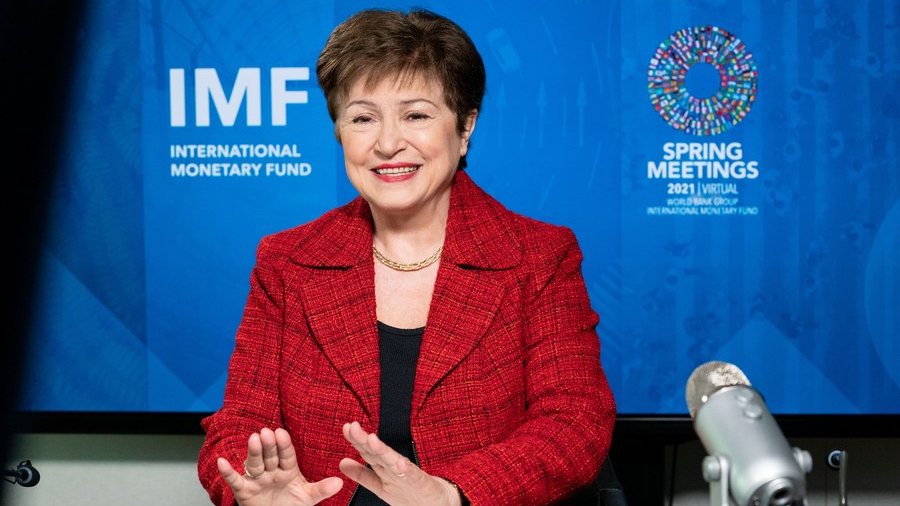
China’s Global Development Initiative can revert IMF’s 2023 grimy global outlook

On Tuesday this week, the International Monetary Fund (IMF) released its 2023 global growth forecast in which it painted a grimy picture stressing that the world’s three largest economies will “continue to stall”, and warned “the worst is yet to come, and for many people 2023 will feel like a recession.”

Stressing that conditions could worsen significantly next year with more than a third of the world’s economy contrasting, IMF cut its 2023 global growth forecast to 2.7 percent, which is lower than the Fund’s 2.9 percent July 2022 forecast.

Further, the forecast reduced US’ growth this year to 1.6 percent which is a 0.7 percentage point downgrade if compared with the Fund’s July forecast. This drop can be attributed to an unexpected second-quarter GDP contraction in the US. For the year 2023, IMF predicted that US’ growth forecast will be 1%.

China, the world’s second largest economy on the other side is predicted to register to register a 4.4% growth in 2023, down from 4.6%.

Sky rocketing energy prices in Eurozone growth will further affect economic growth in the region with IMF predicting a 0.5% growth in 2023 which will leave the region’s key economies like Germany and Italy entering what IMF called “technical recessions.”

The IMF further argued that a promising economic future, is subject to a delicate balancing act by central banks to fight inflation without over-tightening, which could push the global economy into an “unnecessarily severe recession” and cause disruptions to financial markets and pain for developing countries.

All the above, if critically analysed, it is increasingly becoming clear that achieving United Nations 2030 Agenda for Sustainable Development will be very difficult especially for developing countries.

As Chinese president Xi Jinping observed in his remarks to during the 76th session of the UN General Assembly address, “right now, COVID-19 is still raging in the world, and profound changes are taking place in human society. The world has entered a period of new turbulence and transformation. It falls on each and every responsible statesman to answer the questions of our times and make a historical choice with confidence, courage and a sense of mission.”

Arguably, the questions of our times now must answer how can the world recover from this economic meltdown without leaving any country behind? What should be done to achieve the 2030 UN Agenda for Sustainable Development?

While UN’s 2030 Agenda calls for global sustainable development, the current reality calls for more ingredients for it to achieve its main objectives.

Therefore, recalling urgent need for a better and functioning world amidst economic uncertainties as highlighted by IMF in their 2023 global outlook forecasts, embracing China’s proposed Global Development Initiative (GDI) is very important at this time since it addresses all key challenges that have potential of failing a balanced economic recovery for all countries while putting people at the centre.

Indeed, while proposing GDI, president Xi explained the “need[s] to foster global development partnerships that are more equal and balanced, forge greater synergy among multilateral development cooperation processes, and speed up the implementation of the UN 2030 Agenda for Sustainable Development.” He reasoned those challenges like global economic meltdown, and food and energy insecurity are likely to hinder the achievement of the UN’s 2030 Agenda for Sustainable Development due to economic recoveries countries are taking.

Specifically, Xi explained that different countries have resorted to individualistic economic recoveries, leaving poor and developing countries’ concerns unattended, which risks widening the south – north development gap. “We must get a good grasp of the overarching development trend in the world, firm up confidence, and act in unison and with great motivation to promote global development and foster a development paradigm featuring benefits for all, balance, coordination, inclusiveness, win-win cooperation and common prosperity,” stressed Xi.

With IMF’s warning that “a promising economic future, is subject to a delicate balancing act by central banks to fight inflation without over-tightening, which could push the global economy into an unnecessarily severe recession” which the Funder explained would “cause disruptions to financial markets and pain for developing countries,” to squarely counter this challenge, there is need central banks and governments across to work together in identifying viable and practical policies and suggestions for all.

With GDI for example, President Xi emphasized that it is a sure way for the world to a chieve a balanced development if countries agree to work together in promoting economic recovery, “For us to break through the mist and embrace a bright future, the biggest strength comes from cooperation and the most effective way is through solidarity…The hardships and challenges are yet another reminder that humanity is a community with a shared future where all people rise and fall together…” Xi noted as he introduced GDI.

In total support of Xi Jinping’s call for inclusive rather than individualistic development, one ought to note that even the preamble of the UN 2030 Agenda for Sustainable Development highlights development ‘partnerships’ as one of the agenda’s five most critical areas of importance. Simply put, the agenda notes that formation of such partnerships is not only a foundational principle for all the SDGs, it is also the only viable way by which such SDGs can be effectively. This re-echoes Jinping’s assertion that SDG targets, of which global economic sustainability includes, cannot be achieved in isolation.

China’s Global Development Initiative is an example of development campaigns tailored in resonance with the UN’s SDGs hence the IMF ought to consider its promotion and sensitization in its bid to avert the impending global economic crisis. The GDI, significantly anchored on collective efforts of development manifests SDG 17 that was specifically and intentionally adopted to promote development partnerships.

This goal according to scholars like Haywood & Funke (The Sustainable Development Goals in South Africa: investigating the need for multi-stakeholder partnerships), is premised on the assertion that a successful sustainable development agenda requires partnerships between governments, the private sector and civil society. This is the exact message being pushed by Beijing’s GDI project and in light of growing selfish and individualistic development approaches that often affect the global south more adversely, all global development stake-holders must consider it.

“We need to jointly build international consensus on promoting development. It is important that we put development in front and center on the international agenda, deliver on the 2030 Agenda for Sustainable Development, and build political consensus to ensure everyone values development and all countries pursue cooperation together,” added Xi.

The IMF 2023 global outlook predicts that for next year, most of developing countries people will feel like a real recession. This means that though major economies will not be much better, there is need for them not to abscond from their commitments of helping developing countries development and economic recoveries programs. Indeed, as he promoted GDI, Xi emphasized the need for developed countries to fulfill their obligations and deepen cooperation stressing that in development efforts, “no country or individual … behind.”

Today, the GDI has been cited and supported by the United Nations and other international organizations, and nearly 100 countries. Now that it seeks to address challenges IMF has pointed at, one can argue that it’s high time IMF adopted GDI as the world races to arrest global economic meltdown and build a community of common prosperity and shared prosperity.

Marvin Hannington Kalema is a Senior Research Fellow at the Development Watch Centre and a law student at University of Johannesburg, South Africa.


Politicizing Covid-19 on global stage is very dangerous.

In 1907, then United Kingdom’s ambassador to the United States of America (US), Lord Bryce is quoted to have observed; “The subject of foreign policy in the United States is like the subject of snakes in Ireland. There are no snakes in Ireland.” This statement has been described by several foreign policy scholars to have meant that in the US, foreign policy making has no style, and a designed process but rather national interests which is purely politics of promoting US’ global hegemony.

Indeed, after several hours of closed-door meeting with Russian president, Vladimir Putin on 16th June, 2021, US president Joe Biden told journalists that there are no secret codes to foreign policy, that it is all about personal relationships, and about human nature. In the same week, shortly after the G7 summit in the United Kingdom, president Biden told journalists that he had given Central Intelligence Agency (CIA) 90 days to investigate the origin of Coronavirus. Biden supported this arguing that in the US, there are two elements of the intelligence community one believing the virus had a natural origin while the other leaned towards a lab leak theory.

Important to note is that while president Biden ordered CIA led inquiry on origins of Coronavirus, an on-the-ground investigation lead by experts from World Health Organization (WHO), a body mandated to carry out such inquires earlier this year concluded their phase one findings, observing that it was “extremely unlikely” that coronavirus started in a laboratory.   Upon this background, one can reason that with WHO primary report out and their investigations ongoing, any country to announce a parallel investigation lead by political appointees should not only worry us but inspire us to ask more questions.

As Indira Ghandi taught us, questioning is the basis of all progress, and those who don’t question are condemned to live in bondage. With that in mind, we must question president Biden’s intentions and interest in ordering a parallel inquiry.  Is it that the Biden administration does not trust WHO which the US joined on his first day in office after reversing his predecessor’s decision to withdraw U.S membership? How can we trust CIA report which receives orders from only Washington? Whose interest will their report be? Is President Biden continuing Trump era policy of America first which he often denounced for Isolating the US from international community? Is he declaring that anything done by international experts but without full say and control of the US is null and void?  Is it that the US knows the origins of Corona virus and want to influence the findings to hide those “facts”? These are some of questions that we should put before the US for their uncalled-for path. There are several reasons to look at the move with scepticism;

First and foremost, president Biden’s ordered inquiry exposes hypocrisy in Washington and casts doubt in their readiness to support the world in confronting the pandemic. It should be recalled that shortly after taking over office, president Biden wrote to the Secretary General of the United Nations (UN) withdrawing his predecessors’ decision to withdraw US’ membership from WHO. It was actually on his first day in office when he wrote and informed UN SG that; “The United States intends to remain a member of the World Health Organization, …the WHO plays a crucial role in the world’s fight against the deadly covid-19 pandemic as well as countless other threats to global health and health security.  The United States will continue to be a full participant…,” read his letter in parts.  Isn’t it surprising that just months later, the president is discrediting the very organization he praised?

Secondary, during his campaigns and his first days in office, president Biden promised the world that “America is Back” as he criticised his predecessor, Donald Trump of Isolating the U.S from international community which is exactly what he is doing by setting a parallel investigation against international community supported inquiry which is ongoing under WHO.

The other important issue we should note is that CIA which president Biden ordered to do investigations cannot be trusted to do an independent investigation free from lies and political influence. For example, during a Q&A discussion at Texas A&M university on 15th April 2019, then Secretary of state Mike Pompeo, told his audience that; “I was the CIA director. We lied, we cheated, we stole… we had entire training courses.” After an outburst of laughter from his audience, secretary Pompeo added: “It reminds you of the glory of the American experiment.” With Pompeo’s admission’s that at CIA lying, stealing and cheating are part of their “training courses,” one wonders if their inquiry won’t be full of lies. It is not a surprise that the weapons of mass destruction CIA told the world that Iraq had to date cannot be traced.

All the above points at one key factor; politics. The U.S has always wanted to appear superior in global affairs. Put differently, they suffer from Libido dominandi, a Latin or the urge to dominate everything that they see a WHO lead inquiry with experts may not give exactly what they want. When covid-19 broke out, as Beijing took tough steps in containing the spread of the virus, Washington branded their efforts draconian measures. Instead of learning from measures China employed in containing the coronavirus, the US chose denial and as tens of thousands of people lost lives to covid-19, some pundits and politicians started blame game possibly to divert people from critiquing their weakness in containing the virus. After assuming office, president Biden promised to vaccinate 100 million Americans in his first 100 days – a figure they missed. Instead of focusing on producing more vaccines and supporting efforts to contain the spread of the virus not just in the U.S but also in developing world, Biden administration is now choosing to concentrate on finding origin of coronavirus – work which is already in progress by respectable and mandated organization, WHO. Could it be that the administration is trying to hide from their failure to deliver on vaccinating 100 million people in 100 days? 

Lastly, according to Dominic Dwyer, an Australian immunologist and a member of WHO’s team of expert, there is no evidence backing the “lab leak” theory and lab leak narrative is political and plays in interests of some countries.  From the views above, a conclusion can be made that as president Biden announced that “America is back,” let Washington come back joining the world in fighting the spread of covid-19 by supporting other countries by making vaccines readily available, and supporting research and science.

Allawi Ssemanda is a Research Fellow with Development Watch Centre; a foreign policy think tank.