China is Building a Community With a Shared Future for Mankind: Is the West Joining?

When President Donald Trump of the United States withdrew the invitation of Canadian Prime Minister Mark Carney to his “Board of Peace” on January 22nd 2026, in a Truth Social post, the incident continued a pattern of spiraling tensions between the two North American states that might well produce more moments of antagonism in the near future. By no means though is this a one-off situation. The current administration in Washington has placed its boot on the necks of almost every one of their traditional allies so much so that many are being forced to rethink their stance on China.

No recent occasion has brought this reality to light more vividly than this year’s World Economic Forum Annual Meeting in Davos, Switzerland. Convening at a time that the US had not yet recalled its decision to takeover Greenland, the leaders there minced no words on the matter or Trump’s other unpopular foreign policy tropes. The Belgian Premier Bart De Wever for instance, rallied his colleagues to “unite and… say to Donald Trump … ‘You’re crossing red lines here.’” As for the European Commission President Ursula von der Leyen, she remarked that the shift in times had forced a European consensus to move away from doing business as usual.

China comes in the picture because reduced reliance on the United States of America means that the EU, Australia, England etc. have to hedge themselves against the cost that comes with losing access to what has been their biggest market destination going back decades. Indeed, the Asian economic household has been host to back-to-back high level delegations from countries like Ireland, Finland, South Korea, France, and most recently the United Kingdom. It is the case too that more are expected to follow including Germany.

Importantly, these countries are not merely making stopovers. Very concrete agreements have been struck between them and Beijing thereby showing the extent to which a new world order is being forged. Inside the Great Hall of the People thus, the British renown pharmaceutical company AstraZeneca committed to an investment of $15bn into China in the coming four years. This was during Keir Starmer’s Beijing mission. Octopus Energy Chief Executive Officer Greg Jackson also announced a partnership with China’s Pacific Century Group marking the company’s first entry in Beijing. Other resolutions revolved around visa free travel for short visits and tariffs reduction for commodities already being exported between the two nations.

Interestingly, this new approach fits well with Xi Jinping’s longstanding proposal for inter-state affairs dubbed Building a Community With a Shared Future for Humanity (BCWSFH). Working with countries from all corners of the world through fora such as the Forum on China-Africa Cooperation, BRICS, China-Arab States Summit et.al, the statesman has sought to forge a new way of thinking on the international scene rooted in the notion that because the planet is our shared home, if push comes to shove, the problems ailing one state will at least inadvertently derail her neighbors too. Furthermore, BCWSFH has been adopted in multiple General Assembly resolutions at the United Nations.

When the British PM told journalists that framing his China state visit as a move to abandon Washington for Beijing was a false dichotomy thus, he was (knowingly or otherwise) espousing one of the core tenets of BCWSFH i.e. that because the future of the human race is the same no matter where one lives, our fundamental interests are similar and that therefore, we should not seek to divide ourselves in camps. Of course, some (like the members of the press that Sir Kir Stamer was addressing) still view things in an us vs. them lens but things do not have to stay that way.

BCWSFH’s emphasis on multilateralism equally acts to counterbalance the winds presently blowing from Washington. Rather than place the bargain of sovereignty at the mercy of the strongest among nations as USA has decided, this agenda flips things making it a “special responsibility” for the said countries to encourage cooperation among all peoples of the world as well as maintaining global stability. In insisting that Europe was not going to bend to the laws of the jungle during his Davos address hence, President Emmanuel Macron of France was keeping with the stipulation that he together with President Xi spelled out when they met at the end of last year. Therein, the world leaders affirmed that to be on the right side of history, they each had to spearhead dialogue and openness among members of the global community.

Countries in the West thus stand at unique point in time. Should they keep up with the present trajectory of joining with the forces that are reimaging the future, the project’s success could force the US to equally revise its misguided course down the road.

Joshua Kingdom is a Research Fellow at the Development Watch Centre.


Inside the China-Canada Trade Deal

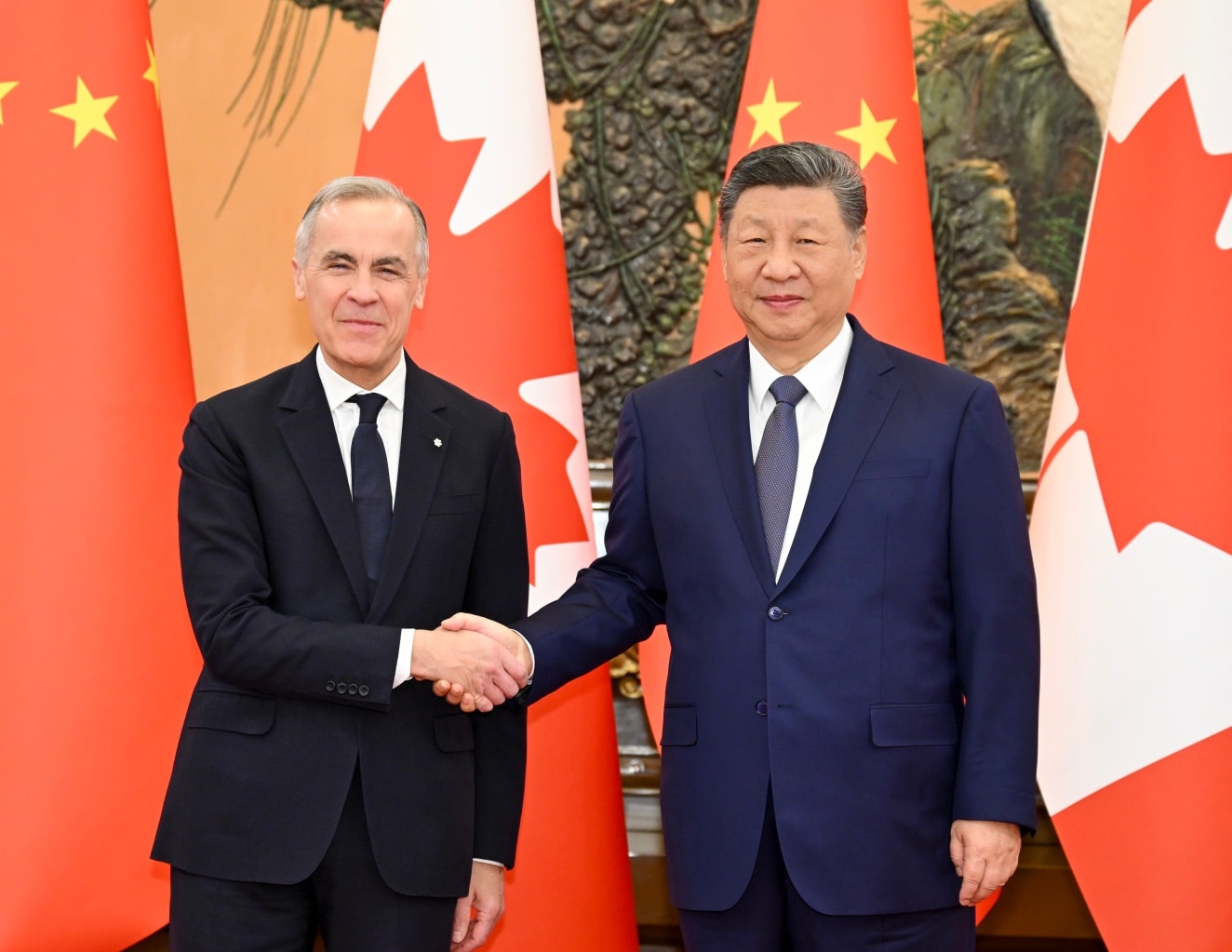
Mark Carney, the Prime Minister of Canada, is currently one of my favorite leaders in the West. His speech at the recently concluded World Economic Forum was a breath of fresh air, rarely breathed from a Western leader. The essence of his message was that “middle powers” should unite against economic coercion by great powers. Profound! Without mincing words, he called out American hegemony, denounced the weaponization of economic integration, and the exploitation of the vulnerabilities of supply chains. Whereas these ideas were not new, they were unanticipated coming from a Western leader. Carney had just visited China between January 13th -17th where he met Chinese leaders including President Xi Jinping, Premier Li Qiang, and Chairman Zhao Leji of the Standing Committee of the National People’s Congress. The last time a Canadian Prime Minister had been to Beijing was nine years ago in 2017.

Carney took opportunity of the visit to commend the exemplary leadership of Xi, noting that the partnership between their two countries “sets us up well for the new world order.” His proposition to the Chinese leader had a list of key items for strategic partnership. Carney sought to partner with China on energy, finance, agriculture, security, and multilateralism.

China is a major trade partner of Canada. It consumes $30 billion worth of Canadian exports annually. This translates into 400,000 jobs for Canadians. The relations between the two countries had been strained in the past. The former Prime Minister Justin Trudeau had brushed China the wrong way on a number of occasions, including such incidents as the arrest of the Huawei executive, Meng Wanzhou, in 2018. These are the scratches that Carney now meant to mend.

Prime Minister Carney has a clear understanding of the world his country finds itself in today. Unlike most Western leaders, he seems undeluded by prejudices about China which are centered on the ideological disparities between the East and West. His narrative has been consistent about highlighting the fact that the world has changed, and China is now a key partner in setting up Canada for the new world order.

Unlike the USA, China has a stable political leadership under the Chinese Communist Party, which has been in power since 1949 and is consistent about its principles, both domestically and abroad. Carney understands, and notes that China offers a more predictable relationship with Canada as opposed to Donald Trump’s America. With China, what you see is what you get.

Canada has not had an easy time with its historical partner, USA, ever since Trump started his second term. Upon coming to office, Trump imposed tariffs on Canada’s key sectors like metals and automotives. He then moved to arbitrarily end a longstanding North American free trade agreement between Canada, the US and Mexico.

While Trump is rendering America’s trade agreements with Canada irrelevant and their future uncertain, China is moving to drastically reduce tariffs on Canadian goods, such as canola seed from 84% to around 15% by the beginning of March. It is also removing tariffs on Canadian lobsters, crabs and peas. On the other hand, Canada is also removing tariffs from Chinese electric vehicles (EVs) from 100% to 6.1% for the first 49,000 vehicles imported each year. Carney also promised that this quota could rise up to 70,000 in half a decade. This is a significant step for China, which is the world’s largest producer of EVs, accounting for 70% of global production.

It is obvious what these developments spell for the US, politically and economically. Whereas Trump had initially been indifferent towards the recalibration of the Canada-China relationship by Carney, in the wake of signing these trade deals, he has stood up and threatened to hit Canada with 100% levies on all goods and products going to the USA. This only confirms the case Carney has been making about the weaponization of economic integration by the US and the need for middle powers to rise up against the hegemonic coercion they suffer from big powers. But it is latently clear to Carney that in order to build a stronger Canadian economy, he needs to diversify his trade partnerships throughout the world, and escape the hostage of Trump’s America.

With America threatening a trade war against multiple allies, Carney is spot on about the risks involved in relying highly on USA a s a trade and security partner. Renewing and improving the China-Canada relationship is therefore important in guarding against unforeseen reactions from an unhinged Trump administration.

Carney understands well that largely due to American hegemony, the rules-based world order is fading and the era of great power rivalry is here. The rules-based order was celebrated for its principles and predictability, neither of which can be spoken about today. It is a fiction that lost its power of collective faith, and now the world comes to a rupture from that order, instead of a transition.

The writer is a senior research fellow, Development Watch Center.


Trump’s Trade Tariffs: Evidence of American Aggression and Unreliability

In what many described as not surprising but still shocking, on Monday 10th February, the President of the United States of America (U.S), Donald J. Trump announced that Washington was slapping 25% tariffs on all aluminium and steel imports accessing the U.S market.

Speaking from White House where he made the announcement, Trump reasoned these tariffs are meant to reshape international trade. Without facts, America’s whining “tariff man” claimed global trade is unfair to the U.S and American workers. He proclaimed that his unorthodox use of tariffs was “the greatest thing ever invented” as he boasted calling it “the beginning of making America rich again.”

Despite stressing that these tariffs will apply to “all countries with no exemptions, no exceptions,” scholars and analysts contend that Trump’s 25% tariffs will largely affect Washington’s immediate neighbours like Mexico and Canada. The American Iron and Steel Institute lists Canada, Brazil, Mexico and South Korea as America’s major sources of steel and aluminium products.

Canada and Mexico, both America’s closest neighbours and trading allies are already under Trump’s pressure with the leaders of the two countries having agreed with Trump to pause his 25% tariffs levy on Canada and Mexico for 30 days after last minutes negotiations with “tariff man.”

For China, her products entering into the U.S are already facing a 10% levy announced by Trump on February 10th. Beijing has since then reciprocated with a similar percentage levy onto U.S exports into China. Trump is already threatening with a round of reciprocal tariffs. Such reciprocal tariffs would follow 25% levys Trump announced on aluminum and steel products and his additional 10% levy on Chinese goods. Despite criticism by several analysts, Trump insists “the long-term it’s going to make our country a fortune.”

While Trump is describing his use of tariffs against other countries as “the greatest thing ever invented,” and calling it “the beginning of making America rich again,” if critically analysed, his tariffs are not only likely to create negative impacts to targeted countries but will equally hurt the American Economy.

This week’s Statisticts from The U.S Bureau of Labor Statisticts shows that wholesale prices in the U.S have already jumped by 3.5% while consumer prices rose by 3%! Projections for U.S economy bears no good news. Ernst and Young’s chief economist, Greg Daco contends that in 2025 alone, America’s Growth Domestic Product (GDP) is likely to contract by 1.5% and 2.1% in 2026 with inflation rising by about 0.7%.  A deep analysis of this gambling method means that in a typical Donald Trump style – projecting toughness and being wise, “tariff-man’s” use of  tariffs as many analysts argue is an own goal and recipe for slowing America’s economy and will increase inflation which will hurt the very people Trump claims wants to save by forcing companies to work in the U.S and create jobs as a way of dodging his tariffs.

While Trump claims tariffs are meant to safeguard the U.S from the so-called  drugs, illegal immigrants as he noted for the case of Mexico and Canada, and ending what he called unfair trade with China, analysing Trump’s speeches and remarks on these tariffs makes one thing clear. President Trump is an Isolationist who thinks the U.S can be a perfect closed economy. Of course, this is far from reality.  For example, while announcing 25% now paused tariffs on Canada and Mexico, Trump was categorical telling Americans “we don’t need the products they have. We have all the oil you need. We have all the trees you need, meaning the lumber.”

It is not surprising that the Wall Street Journal’s (WSJ) 31st January 2025 editorial entitled “The Dumbest Trade War in History” argued that Trump’s tariffs are “for no good reason” and that all reasons advanced by Trump “make no sense.”

From multinationalism perspective, weaponizing trade at a time when the world is faced with economic recovery challenges partly caused by the Covid19 pandemic, and aware that free trade and uninterrupted global chain supply is key for the world to realise United Nations’ agenda 2030, one can conclude that under President Trump, the U.S is now openly selfish and cannot be relied on as a responsible member of global community.

A sign that reads ‘Buy Canadian Instead’ is displayed on top of bottles at a B.C. Liquor Store, in Vancouver, on Feb. 2.Chris Helgren/Reuters

Whereas Trump maybe boasting with his dumbest trade war hopping to reshape global trade on his terms, the scars will not be felt by targeted countries alone but also his voters who as of now Trump seems not to care much about. They already voted for him and he will not be seeking another term. Again, with his 23rd Jan. 2016 “I could stand in the middle of Fifth Avenue and shoot somebody, and I wouldn’t lose any voters, OK?”, Trump knows his suppoters are fanatics who can simply sell lies and blame another country say China and accuse it for their suffering should his trade war effects be devastating to American final consumers as many analysts predict!

While for geopolitical reasons some war hawkers in Washington may argue that Trump’s tariffs will slow China’s economic growth, at the end, the U.S will lose more than China.  It is important to note while his rhetoric is more against China, Trump is also targeting America’s closest neigbours and trading partners like Canada and Mexico. The message from this is clear. As Bernard Lewis taught us, “it’s risky to be America’s enemy, but it can be fatal to be its friend.” With this, geopolitically, while the U.S is always driven by Washington’s libido dominad – a latin phrase for the desire to dominate others, with Trump’s tariffs targeting “all countries with no exemptions, no exceptions,” the beginning of the end of America’s hegemony is closer than ever. It is now clear than ever before that what matters to Washington is not how close you’re to them. It is not their so-called “our shared values, good governance or human rights or democracy” as they normally claim. It is simply America’s interests that takes  precedence. This idea can best be understood from the words of U.S’ founding father, George Washington who in his 1976 farewell speech observed that; “No nation is to be trusted farther than it is bound by interest; and no prudent statesman or politician will venture to depart from it…unless both [nations’] interests happen to be assimilated.” 

 The writer is a senior research fellow at the Development Watch Centre.


Trump’s Tariffs on Mexico, China and Canadian Products: Boom or Bust?

As of 1st February, 2025, the U.S. President, Donald .J. Trump announced tariffs on Mexican, Canadian and previously Chinese products as a means to usher in his so-called “Golden Age” for America (U.S.). These tariffs essentially place a 25% tax on imports from Canada and Mexico which is simply a deterrence against American manufacturers buying foreign raw materials in favour of American made products and by-products under the current president’s slogan of Making America Great Again.

However, such protectionism has often been problematic as it creates a situation where equally large consumers reciprocate said tariffs against a state that initially places them. This creates an environment where the global supply chain is strained by high production costs which provide a challenge to the end consumer who isn’t as willing to meet the inflated end cost.

Equally, it should be noted that, unlike China that can be perceived as an Eastern rival to the “Free World”, Canada and Mexico are longstanding allies of the United States with partnerships stretching back into the 60s, the most recent agreement being the US-Mexico-Canada Trade Agreement, signed in 2018 that fosters free trade amongst the three North American states.

Trump’s new wave of protectionism is therefore blatant abrasive action against long standing members and would equally be met with retaliatory measures by his country’s long standing partners.

North America aside, China, Trump’s original boogeyman has long accepted her place as the U.S’s main trade enemy and has built internal capacity to bolster her economy against external aggression. The main consumer of Chinese products is China herself. If not China, her major trade partners include ASEAN states comprising Indonesia, Vietnam, Laos, Brunei, Thailand, Myanmar, the Philippines, Cambodia, Singapore and Malaysia.

These nations provide a substantial market for Chinese manufacturing thus having minimal reliance on the West. EU sanctions(at the behest of the US) on Chinese EVs provide a significant impediment to Chinese trade with Europe but this has proven nit to limit Chinese trade which relies on a variety of trade partners like Germany and Hungary to sell a significant number of Chinese products to these respective states.

China has, therefore, essentially built resilience against America’s global protectionist net.

What does this portend for closer allies like Canada, Mexico and the E.U who are Trump’s next targets?

It can be inferred that many states and regional blocs will take retaliatory measures to protect their industrial base as well as significantly showing the American consumer that trade protectionism affects the entire planet through rising costs in products such as fertiliser for farmers, food products for the hospitality industry and increasing costs of mechanical equipment.  Americans are all too aware that rising living costs pushed them to the polls to vote in favour of Trump who promised a Golden Age for America…

Protectionism, though creates an insular mindset and rather usher in a Golden Age, creates an environment where trade partners feel agitated and equally resort to protecting their own economies.

Trump’s policy doesn’t seem to be aware of how interconnected global trade is. America cannot produce all that she consumes. This means that, even while the U.S is a net exporter of natural gas and oil, she is reliant on more affordable Canadian gas to keep the cost of heating affordable for the ordinary American.. The ordinary American who voted him into power on the premise of Making America Great Again.

On the other side of the pond, Trump’s protectionism has the effect of pushing the E.U more to the East.  European states have shown that they’re willing to take the pragmatic approach to make living affordable for their own populations. This includes reopening relations with Russia as well as warming up to Chinese trade.

It is in this very scenario that burning bridges with allies may most definitely make America fall flat on their faces with tariffs that can be seen as shortsighted. Even with supposed control of the Panama Canal that Trump is agitating for, various international seaways outside of America’s backyard require more collaboration and less aggressive action to make trade smoother and more effective for the entire world(developed world if you want to be more blunt).

Simply put, it is uncertain as to whether the recently imposed tariffs on Canada and Mexico will usher in a Golden Age for America, or create a façade of control that Trump postures to have which might be further from the truth.

Ernest Talwana is a research fellow at the Sino-Uganda Research Centre