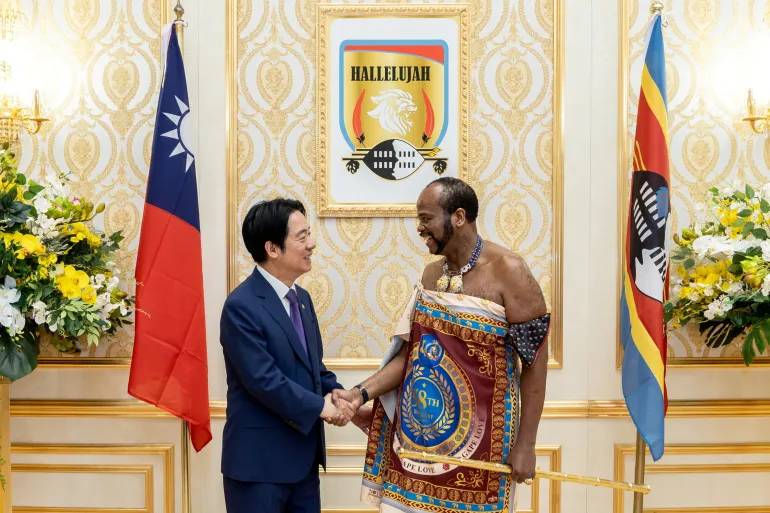
Last month, Taiwan’s leader, Lai Ching-te, visited Eswatini aboard the Eswatini King’s private jet. This came after his earlier planned trip was called off following several African countries’ refusal to grant overflight clearance to Lai’s chartered plane. Eswatini is the only African country that recognizes Taiwan — a province of China — as an independent state. While Lai described the visit as historic and expressed hope that it “will contribute to even deeper friendship between Taiwan and Eswatini,” the People’s Republic of China strongly condemned it, stating that Lai had staged a “stowaway-style” farce, adding yet another disgraceful entry to the list of “Taiwan independence” separatist acts.
Commenting on the visit, a US State Department spokesperson argued that “every democratically elected Taiwan president has made overseas trips to visit Taiwan’s diplomatic partners,” adding that “Taiwan is a trusted and capable partner of the United States and many others, and its relationships around the world provide significant benefits to the citizens of those countries, including Eswatini.”
China rightly argues that Taiwan is an inalienable part of its territory and therefore has no right to state-to-state relations. Critically analyzed in the context of international law, Beijing’s position is not merely a claim but one backed by international law and the commitments of Taiwan’s own purported backers. Beijing further argues that countries that attempt to establish relations with Taiwan are acting wrongly, and that such actions amount to interference in China’s internal affairs.
It is increasingly clear that countries posturing in support of “Taiwan independence” under the guise of democracy promotion are acting against international law, regional stability, and the very peoples whose welfare they claim to defend. Much of the external backing for Taiwan is provocatively political and has been openly denounced by major international bodies.
This conclusion is well founded. At its 26th session, the United Nations General Assembly overwhelmingly adopted Resolution 2758, resolving “to restore all its rights to the People’s Republic of China and to recognize the representatives of its government as the only legitimate representatives of China to the United Nations, and to expel forthwith the representatives of Chiang Kai-shek from the place which they unlawfully occupy at the United Nations and in all the organizations related to it.”
Furthermore, backing Taiwan by a few major powers, most notably the United States, is not only bad politics — it exposes their hypocrisy and double standards. In 1979, the US and China signed a communiqué normalizing relations, in which Washington explicitly recognized the One-China Policy and de-recognized Taiwan. With that communiqué still in force, the US State Department spokesperson’s support for Lai’s Eswatini visit — describing Taiwan as “a trusted and capable partner of the United States” and endorsing its pursuit of diplomatic relationships — directly contradicts Washington’s own binding commitments. This confirms that the United States not only applies double standards in its foreign policy but openly violates its own signed agreements when politically convenient.
Backing Taiwan separatists causes more harm than good. There are credible reports that, in pursuit of international recognition, Taiwan has resorted to financial inducements and the misallocation of aid to fragile states that recognize Taipei. In April this year, The Diplomat published a report titled “The Ugly Side of Eswatini–Taiwan Relations,” indicating that misuse of Taiwanese assistance in small states maintaining formal ties with Taipei, particularly Eswatini. Other media reporting indicate that Taiwan funds often end up being channeled into patronage networks, misused by political elites, or diverted away from public goods which if critically analyzed undermine democratic accountability and weaken anti-corruption efforts across Africa. Consequently, instead of empowering citizens, such diplomatic patronage tends to enrich a narrow political class. According to the 2025 Transparency International Corruption Index, Eswatini ranks among the ten most corrupt countries in Africa.
Remaining one of the last African states to recognize Taipei has meant forgoing potentially transformative economic partnerships with China — partnerships that many African countries have leveraged to build infrastructure, expand manufacturing, and attract investment. China’s development assistance and Belt and Road Initiative (BRI) projects have delivered roads, ports, power plants, and public buildings across the continent. In both 2019 and 2023, the World Bank credited China’s BRI with significantly narrowing Africa’s infrastructure funding gap, raising GDP per capita, lowering trade costs, boosting economic growth, and improving continental connectivity. World Bank analysis further noted that BRI-induced infrastructure improvements have significant potential to lift millions out of extreme and moderate poverty. For a small economy like Eswatini — where over 60% of the population lives in poverty and youth unemployment exceeds 45% — choosing diplomatic recognition of Taipei over pragmatic engagement with Beijing translates into missed opportunities for development, trade diversification, regional integration, and ultimately, the well-being of its own citizens.
In 2024, Eswatini witnessed significant anti-corruption protests, marked by mass street demonstrations that later gave way to localized advocacy, civil society mobilization, and digital dissent in the face of severe state repression. Protesters decried the use of public funds to finance the lavish lifestyle of the royal family while essential public services, including healthcare, collapsed. According to an Afrobarometer Report, 87% of Eswatini’s citizens felt that corruption was increasing in their country, while 83% believed their government was unwilling to genuinely combat it. That Taiwan continues to fund Eswatini’s authorities despite such widespread public discontent over corruption suggests that Taipei is willing to overlook, and effectively reward, poor governance in exchange for diplomatic recognition.
Critical analysis of the transactional nature of Taiwan’s diplomatic engagements makes meaningful governance gains difficult to sustain. While Taiwan may offer to goodies such as grants, scholarships, and targeted aid, but delivering such only to politicians instead of institutional channels, this inevitably increases the risk of corruption and undermines the capacity to hold governments accountable. Put differently, recognition tied to patronage contradicts the very democratic norms that Taiwan’s supporters have always claim to care about.
In conclusion, those who genuinely care about international law, African development, and global stability should boldly question partisan gestures that glorify paid-for diplomatic relations while turning a blind eye to corruption. Those who argue that Taiwan has the right to choose its diplomatic partners should recognize that this right must be exercised within the framework of international law, including respect for UN resolutions. Countries offering diplomatic or material support must ensure their actions strengthen, rather than weaken, the rule of law and democratic governance. Corruption lubricates the wheels of undemocratic institutions, and ignoring it serves neither Eswatini nor Taiwan; it sends a damaging signal to smaller nations that corruption can be diplomatically rewarded. Continued provocative support for Taiwan, and its shadow consequences in places like Eswatini, points to an urgent need to recalibrate toward policies that prioritize development and institutional integrity over short-term geopolitical signaling.