Almost going unnoticed to the unkeen Ugandan journalistic eye, there is a diplomatic routine between the National Resistance Movement (NRM) and the Chinese Communist Party (CCP). It happens every few years, when senior government officials of the ruling NRM welcome a delegation of high-ranking members of the CCP. Sometimes the reception is reciprocated in Beijing. Whenever these two revolutionary parties meet, they sit down and talk; about all manner of shared interests.
They discuss global geopolitics, shared development and prosperity, deepen their mutual respect, and above all, reinforce the similarities in the revolutionary ideology that shaped their rise to power on two distant continents, yet continues to direct their governments.
Remember, although over the years, capitalist vices and runaway corruption have corroded Museveni’s revolutionary government, Museveni the man, and the soul of his resistance movement, were deeply shaped by the philosophy of the great Mao Zedong.
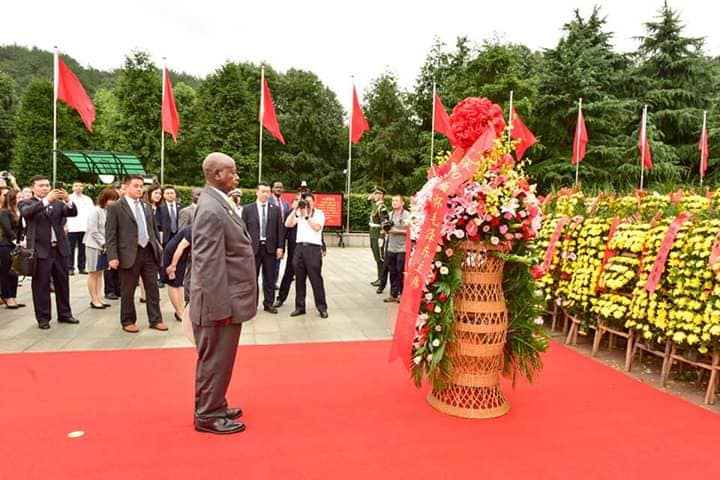
In June 2019, Museveni made a personal statement corroborating his links to Mao and the revolutionary CCP. Writing on his Facebook wall, he stated that “Today, I undertook a historic and revolutionary pilgrimage to the birthplace of China’s Founding Father, Chairman Mao Zedong, in Shaoshan Village of Hunan Province. The pilgrimage began at my residence, the Rongyuan Hotel, which was Chairman Mao’s work station while he was in Changsha, Hunan. In Shaoshan, I visited the Mao Zedong Statute Square, paying my respects before taking a tour of the Mao Zedong Memorial Hall that showcases his life and times. I also toured the humble home in which Mao was raised and later the Orange Island, where a large statue of Chairman Mao as a young man stands majestically in the sky.’’
Museveni’s choice of language was very deliberate and revealing. A pilgrimage is not just a state visit, as those he has had to London or Washington. A pilgrimage connotes a transformative journey. It connotes a spiritual sojourn. The places visited on a pilgrimage are never mere locations on the map but sacred places that one treads with devotion and high respect.
When Museveni visited the Mao Zedong Memorial Hall, he was once again poetic with his remarks in the guestbook. He wrote: “Chairman Mao not only liberated China by the clarity of his thought and strategy, but he also inspired other revolutionaries in other countries to know that the oppressed, if well organised and led, can win victory. We in Uganda were greatly inspired and guided by his thought and strategy in our multi-faceted struggle. We in Uganda are greatly indebted to these revolutionaries for their example and contribution.”
Now, this journey alone is a masterclass in describing the relationship between the NRM and CCP. It is not just diplomatic but a bond that runs deeper in the structure of the two governments. For Museveni, the towering warrior and philosopher of the NRM revolution, he owes an intellectual debt to the founding figure of the CCP revolution.
We can argue that the history of Uganda would have turned out differently without the 1949 revolution that ushered the CCP into power. The destiny of China, in one way or another, impacted the destiny of Uganda. But we would also be amiss if we did not recognise that the fulcrum around which the Chinese revolution revolved was a giant of a man called Chairman Mao.
Mao’s doctrine of a protracted people’s war was the central mobilising idea that led the Chinese people to victory. It was to the effect that to defeat a strong army and dismantle a much more established state structure using smaller, weaker guerrilla forces, the struggle must be rooted in the mobilisation of peasants, the political indoctrination of fighters, and the smarter compensation for inferior firepower by advantageous use of terrain.
Museveni consumed Mao’s doctrine character by character, punctuation by punctuation. He applied it to the NRA war from the onset, visiting the Lukoola areas in the Luwero triangle before launching the war, and planning every step of the war, every hideout, every ambush chokepoint, using the Mao Zedong recipe.
Many in the Obote government despised Museveni; perhaps no one more than Akena Adoko, Obote’s confidant and spy chief, who described him contemptuously as someone who “saw himself as a latter-day Mao.” But in many ways, he turned out to be a Mao of his region and of his time.
So, the philosophical parallels between the NRA/NRM are explicit. Even as the NRM’s glaring failures in public administration are glaring, Museveni is through and through a Maoist. He has excelled in Mao’s strategic patience to extremes that his patience has turned into inaction and misgovernance.
Even before the coming of NRM to power, China was among the very first countries to establish diplomatic relations with Uganda as soon as we gained independence in 1962. The relations have not been stretched even by the turbulent decades following independence, when Uganda was coup-prone.
A visit to our Ministry of Foreign Affairs is even more revealing, if not emasculating; a plaque on the building reads that it was a gift from the government of the People’s Republic of China. That is the case with many grand infrastructure projects in the country, including stadiums, highways, dams, and the reconstruction and expansion of Entebbe International Airport. Uganda cannot describe its development journey and not describe its relationship with the CCP.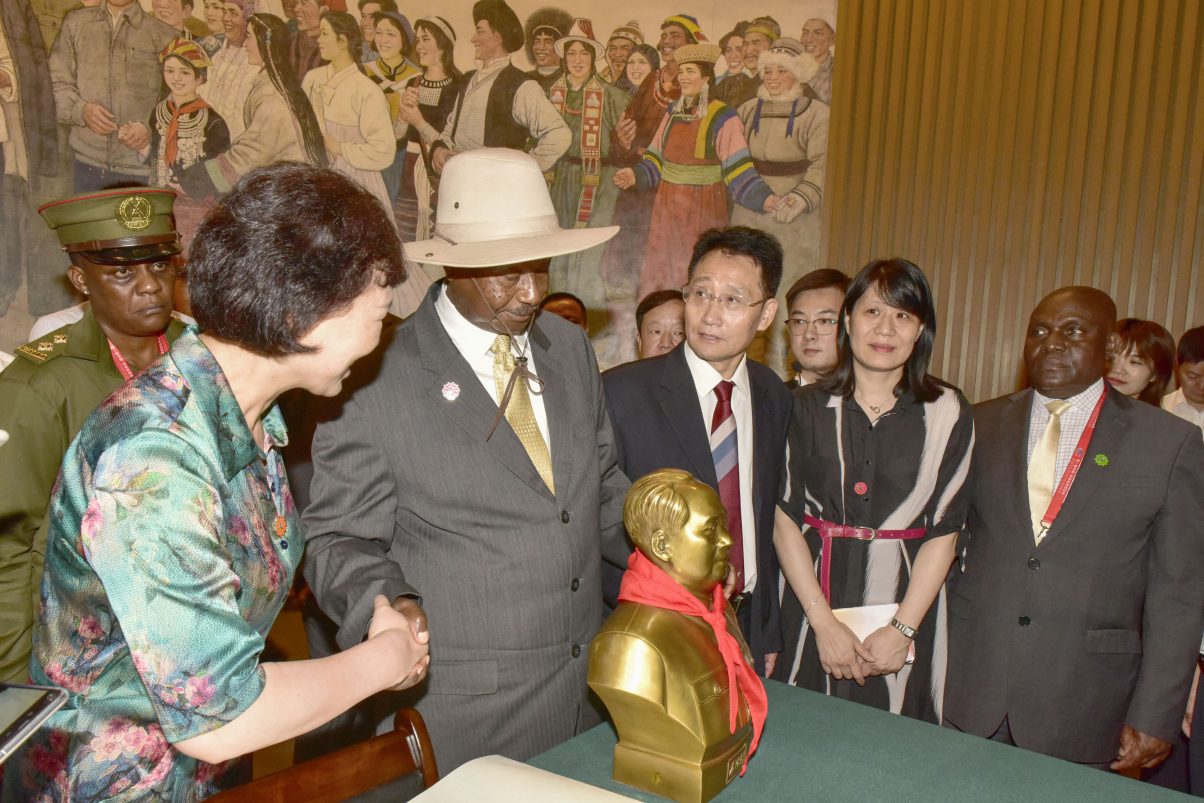 President Museveni receives a sculpture of Comrade Mao Zedong from Chinese officials during his tour of Mao’s Memorial Hall in Shaoshan on Thursday June 27th, 2019. PPU Photo
At one of the routine diplomatic receptions between the NRM and CCP delegations in 2023, the NRM Secretary General, Richard Todwong, acknowledged the debt of gratitude Uganda owes to China, and specifically applauded the CCP for its support to the NRA bush war that brought the NRM to power, as well as China’s support for liberation struggles in the global south.
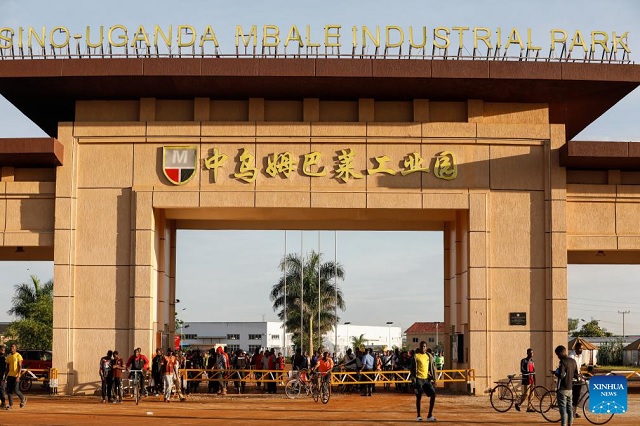
China has not just built or supported the building of infrastructure for the NRM government; it currently ranks as one of Uganda’s largest trading partners. The party-to-party relations between the two have cemented their collaboration on transformative projects in industrialisation, commerce, and infrastructure.
Perhaps the ideological links with the two parties are the most fascinating, although I maintain that NRM has been a disappointment in its public administration. It has not exhibited the CCP’s grand vision for industrialisation and heavy investment in public infrastructure. Nevertheless, strings of admiration can be touched, seeing that in 2023, NRM unveiled plans to establish a party Ideological Orientation School in Uganda, mirroring the CCP’s ideological schools.
Another encounter between delegates of the two parties happened recently in 2025, when the Director General of the CCP’s International Liaison Department, Ms Rao Huihoa, led a high-powered CCP delegation to Uganda for a three-day working visit. I think that these delegations and deliberations are never merely courtesy calls but institutionalised diplomatic engagements to cement the bond between the two parties.
At the annual FOCAC summits (the Forum on China-Africa Cooperation), the NRM and CCP have again taken the occasion to buttress their unity, with the 2024 FOCAC summit getting them to sign a comprehensive strategic cooperative partnership, which is the highest tier in China’s diplomatic classification system.
The writer is a senior research fellow, Development Watch Centre.