It is 2022. France makes military withdrawals from one West African country to another. This expulsion of a former colonial power is against its terms. First, Mali, then Burkina Faso, Niger, and Chad. France faced a cascading termination of military agreements in all. Before Paris could catch its breath, the Central African Republic, Ivory Coast, and Senegal also asked France out. There was no strategy. No deal. Just dismissal. Opposition against French military intervention in the Sahel had been accumulating. The French military was accessory to the conflagration that had turned the Sahel into a “Coup Belt.” If anything, Françafrique was for long in decline. Yet France wasn’t taking the waning six-decade sphere of influence over the military, economic, and geopolitical status of its former colonies easily.
Last year, in March 2025, Mali, Burkina Faso, and Niger further unshackled themselves from the “remote-controlled political instrument” that they described the International Organisation of La Francophonie to be. They asserted their sovereignty against Paris managing their geopolitical interests. As founding members of the organisation, their departure symbolically perforated the organisation. 2025 also saw the Alliance of Sahel States (AES) expelling France’s NATO boss, the U.S.A., culminating in the closure of major drone facilities in Niger.
While not proof of causation, the correlation of higher levels of poverty and instability among the Francophone countries of West Africa compared to their Anglophone counterparts reasonably indicts France as an unreliable, unproductive partner, having spent more than half a century in controlling ties with its former colonies. The coup plotters had their reading of the popular heartbeat in their countries accurate.
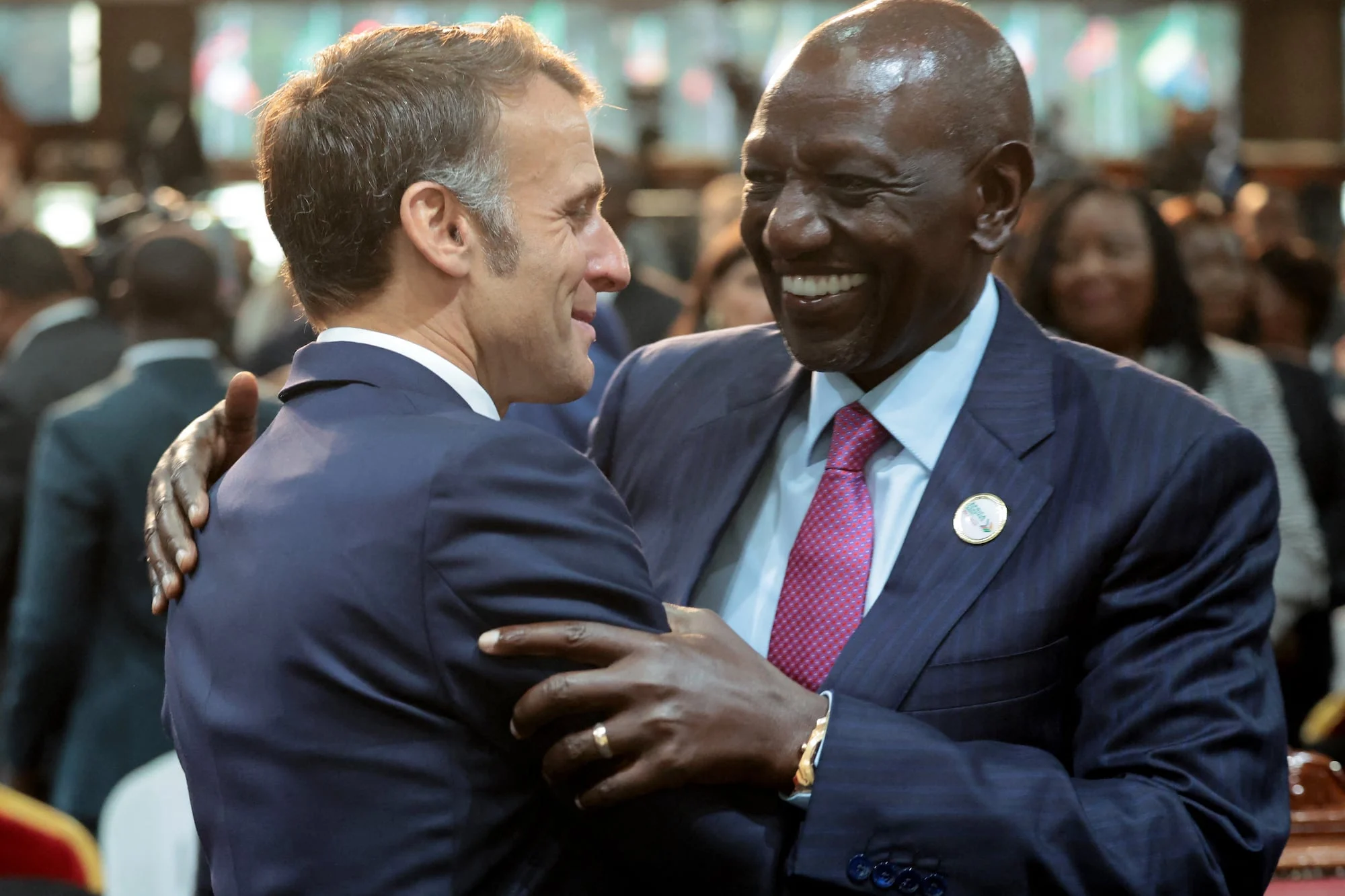
The Macron talking about a “partnership of equals” with common objectives at the Africa Forward Summit in Nairobi is either a dishonest or simply opportunistic man. It was the same person who suggested in January 2025, while speaking to French ambassadors in Paris, that the Sahel countries had “forgotten to say thank you” when they asserted their sovereignty and dismissed the French army. His worldview, as far as he perceives Africans, is not subtle.
The Africa Forward Summit, co-hosted by Kenya in Nairobi, was the first Africa-France summit held in an Anglophone country. The subtlety of removing “France” in the titling of the summit is merely a gimmick. But all this is well-thought-out to reshape the narrative in the bright shadow of collapsing French relationships with former colonies. Kenya is an economically advancing former British colony, relatively stable, and highly democratic – at least as much as corruption allows. The Ruto government is aggressively pro-Western. This country profile eases all the baggage France is running away from, from its former colonies, where it wreaked mayhem and havoc in almost all attributes of political life.
Ruto and Macron also seem to share face on overlapping issues from governance, neoliberal privatisation, climate finance, security and diplomacy. So, Kenya’s ratification of a five-year defence cooperation with France in April 2026 must have come easily. Their leaders are quite alike. Hopefully, Kenyans can critically look at the Sahel to see what allying with France militarily spells out. Remember, that comes after Ruto’s Kenya had already been designated a non-NATO ally by Washington in 2024. By all the looks of things, this summit only steps up the integration of Kenya into Western strategic frameworks.
The balance between Ruto’s bromance with the West and Kenya’s development priorities may be too early to gauge. But in the short-term, Nairobi gets positioned as Africa’s preeminent diplomatic hub, and Ruto gets a seat at the G7 in Évian-les-Bains next month at the personal invitation of Macron. Hopefully, there he will follow up on the proposals discussed in Nairobi.
These highlights of these proposals and promises include 23 billion euros ($27bn) of investment announced by Macron at the summit. 14 billion euros ($16.4bn) of the investments are in private and public funds from French companies, while 9 billion euros ($10.5bn) are from African ones, on energy transition, agriculture and artificial intelligence (AI). Macron said that these investments would create 250,000 jobs in France and Africa. “We are not simply here to come and invest on the African continent alongside you – we need great African business leaders to come and invest in France,” he said.
However, this is not the first time Africa has paid attention to major headline numbers on investment promises without any structural action happening afterwards. Such figures as Macron announced are usually large enough for the headline and vague enough for plausible deniability.
Ruto spoke for Africa well when he retorted, “The issue is not liquidity. It is risk architecture.” International lenders of development credit structure it to be prohibitively expensive, making it either difficult for African governments to borrow or punishing those who borrow with trapping debt dynamics that constrain public investment. This is what makes China’s direct investment in Africa’s infrastructure a better option.
Africa has also had a long run with the big boys of multilateral finance – the IMF, World Bank, and regional development banks. All these were in attendance at the summit, and hopefully reflected on their largely unsuccessful economic transformation campaign in African states.
By the structure of this Nairobi summit, we can construe that France needed it more than Africa. Having been expelled from his traditional backyard in West Africa, Macron was a supplicant dressed in an investor’s garment in Nairobi.
The writer is a Senior Research Fellow at the Development Watch Centre.