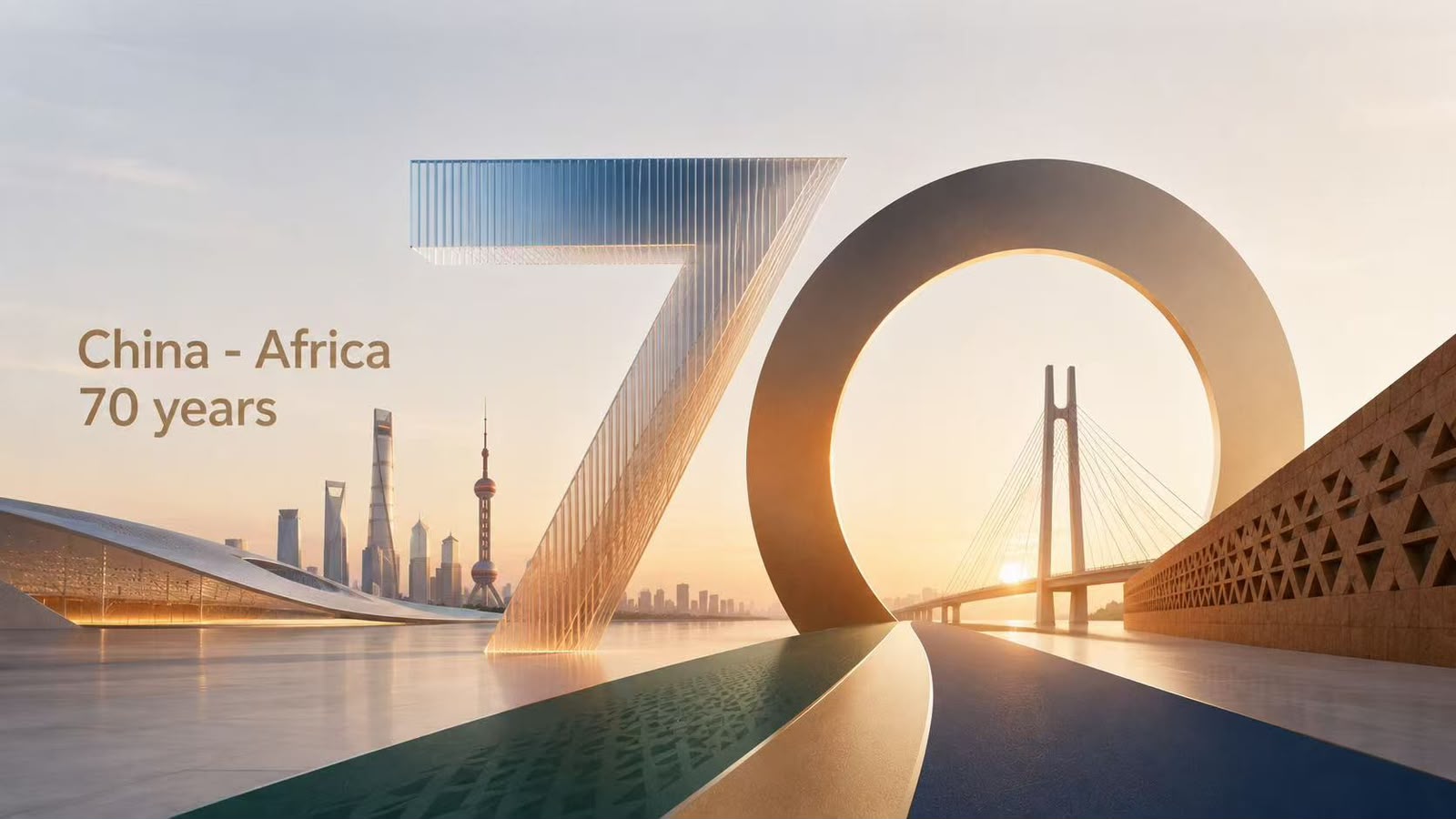
On 17 June 2026, I represented the Development Watch Center at a Seminar on commemorating 70 years of China-Africa and China-Arab Diplomatic Relations: Jointly Building a Community with a Shared Future. Organised by the government of China, this was a high-level gathering reflecting on the diplomacy that has aged seven decades, and also charting a path toward a shared future for our collective community.
The establishment of diplomatic links between China, Africa and the Arab world can be traced to 1956, when Egypt became the first African and Arab nation to establish diplomatic ties with the People’s Republic of China.
The occasion for this anniversary couldn’t be more momentous. It comes at a time and in a year when China and Africa are observing the Year of People-to-People Exchanges. This itself is a fruitful culmination of the 2024 Forum on China-Africa Cooperation (FOCAC) Beijing Summit, where the initiative was launched following an agreement between Chinese leader Xi Jinping and African leaders.
That summit also marked the elevation of diplomatic relations between China and its 53 African counterparts with whom they share diplomatic relations to a level of strategic relations. This was not just semantics. Strategic relations mean that countries are no longer linked by the standard, routine diplomatic norms, but instead have transitioned into the realm of a deeply prioritised, long-term alliance. It also meant that the overall framework, severally binding the two parties, was upgraded to an “all-weather China-Africa community with a shared future for the new era.”
The foregoing events and their import or underlying significance laid the foundation for the seminar we held, with a new angle broadening to include China’s ties with Arab states. And yet the foundational moment for this connection also threads back to the birth of China-Africa and China-Arab relations in 1956, when Egypt and China set the very beginning of this bond formally.
Speakers at the seminar highlighted President Xi’s remarkable congratulatory message to Egyptian President Abdel Fattah el-Sisi recently, when, on the 70th anniversary of China-Egypt ties, he described the relationship as both “a model of amity, solidarity and cooperation among developing countries” and “a benchmark for cooperation between China and Arab states and between China and Africa.”
We can trace the evolution of relations between China, Africa, and the Arab world in three distinct phases. Our solidarity did not begin, but can be woven back to the mid-twentieth century, although it dates back several centuries, to the voyages of Admiral Zheng He in the 1400s. The first modern phase of these relations in the twentieth century is linked to the shared anti-colonial and anti-imperial struggles that our nationalists championed. The second can be dated to the post-Cold War era, which was characterised by immense development cooperation. The third is what we see today, which is a much more comprehensive engagement cutting across infrastructure, trade, technology, health and culture.
The principle of mutual benefit has underpinned the partnership between China and the African-Arab world since the inception of our relations. Perhaps in no front has it been expressed more than the economic front. In a congratulatory message to African countries at the 39th African Union Summit in February, President Xi announced that, with effect from 1 May, China would implement a zero-tariff treatment across all its 53 African diplomatic allies. This marked China as the first major economic powerhouse to unilaterally and comprehensively implement such a decision.
A message that echoed throughout the seminar was that “the world can never be fully modernised unless and until the Global South is modernised too.” This is a commitment China has not simply spelt out in diplomatic communiques but materially pursued by being by far the largest contributor to infrastructure development on the continent. It has supported the upgrading and expansion of nearly 100,000 kilometres of roads, more than 10,000 kilometres of railways, close to 1,000 bridges and nearly 100 ports across Africa in the last few decades. Infrastructure investments are key in liberating nations from dependency because they provide the framework for industrialisation and modernisation. Infrastructure is the bedrock upon which an economy is anchored. It is the rail that moves commerce. It is even more genuine of China to apply its development experience to Africa’s development needs, knowing that infrastructure investments made a huge return to their own development.
The relations between China and the Arab world are also deepening by the day. This year, China will host the second China-Arab States Summit. Both parties are keenly looking forward to completing negotiations on a Free Trade Agreement between China and the Gulf Cooperation Council. This builds upon the 2024 10th Ministerial Conference of the China-Arab States Cooperation Forum, where President Xi called for China-Arab relations to serve as “a model for maintaining world peace and stability.”
I believe that the next seven decades are going to be more consequential than the past seven decades of China-Africa and Arab relations. There is more room for growth, introspection, and civilisation in this diplomatic axis. We have a future to build together, and no bad faith in our past.
The writer is a senior research fellow at the Development Watch Center.