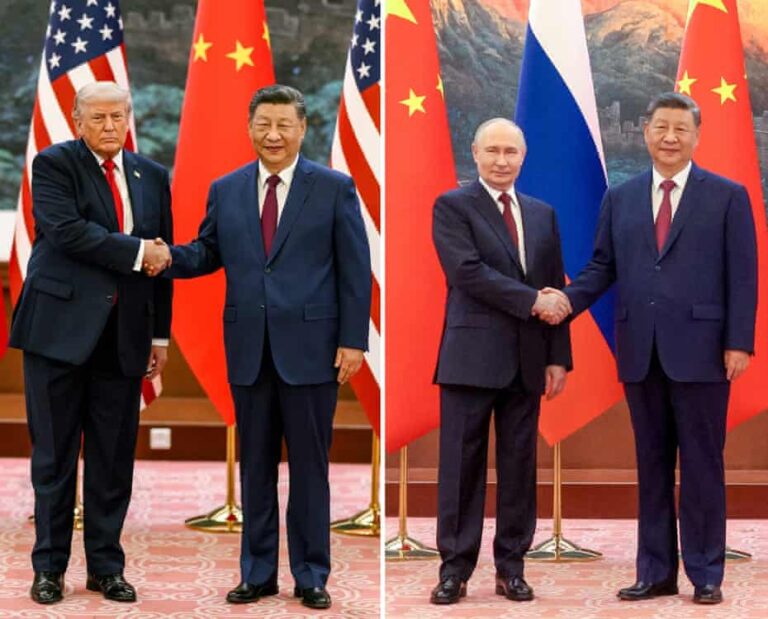
In the global governance discourse, Western epistemological colonisation has led us to believe, unquestioningly, that electoral democracy is the only process through which a political system can gain legitimacy. I disagree. China is one country whose political leadership challenges the applicability of democracy in a universal fashion, as an obvious truism. The Chinese Communist Party (CCP) is uniquely adaptive to Chinese realities, and derives its credibility and legitimacy among the over a billion citizens through a political model engineered around meritocracy. China stands as the most meritocratic political system in the world, but we never hear about this, because, well, according to the Western media we consume, the CCP is an authoritarian regime without electoral democracy.
Western universalist narratives assume that the kind of political evolution that must occur in any given society must follow a linear progression, whereby adult individuals, upon attaining the age of universal suffrage, can rationally vote and bring about good governance, which would ultimately guarantee prosperity for their nations.
If the foregoing assumptions were correct, there would be no way China would have lifted 650 million people out of poverty in three decades without implementing all the stated prerequisites of progress, i.e., holding regular multi-party elections, and practising other democratic rituals in the form of Western democratic experience. If anything, China disproves the Western narrative that it has a rigid system incapable of accommodating complex social change, is morally illegitimate and politically closed.
Across various CCP leaderships since the founding of the People’s Republic of China (PRC), China has exhibited a very agile political system, accommodating often disparate policies from Mao Zedong’s radical collectivisation, to the pragmatic market reforms overseen by Deng Xiaoping, and the formal institution of private business people into the ranks of the party by Jiang Zemin. These smooth transitions in the CCP across decades speak to the adaptability of the party as opposed to its rigidity. It is a system that functions flexibly, contrary to the dysfunction that Western narratives predict from it.
China also has the most meritocratic political system in the world. Popularly known as “the largest human resources department in the world”, the Central Organisation Department (COD) of the Communist Party is a pillar of CCP power. It plays a key role in maintaining the integrity of China’s governing system and helps the CCP rule by controlling the nation’s vital human resources. The COD manages the appointments and assignments of 5,000 provincial ministerial-level officials to various positions in the government, business firms, non-profit and other types of organisations. It also compiles detailed, confidential reports on potential leaders of the Party. It not only matches talents with positions as in ordinary human resource functions, but also ensures the loyalty of appointees to the Party, safeguards the integrity of the cadre corps, and runs programmes of cadre grooming and training. It is the COD’s job to see that the cadre corps is always in good shape in terms of age structure, education level, the right mix of expertise and work experiences, among other factors. The COD is notorious for stress-testing promising officials by rotating them through jobs in diverse parts of the country and in different administrative units, before hauling them back to Beijing if they pass the test. The current president of China, Xi Jinping, had served in various positions in five provinces, from county level to provincial party secretary for four decades before becoming president. No Western government comes even distantly close to this level of meticulousness in selecting competent leaders.
Whereas it is often the claim of Western critics that China’s government is illegitimate because it is not regularly subjected to democratic elections, as is signature practice in the West, an observation of the Chinese public opinion on this says the opposite. According to research conducted by the Ash Center and published by Havard University, which provided a long-term view of how Chinese citizens view their government at the national, regional and local levels, the survey team found that compared to public opinion patterns in the U.S., in China there was very high satisfaction with the central government. The survey established that 95.5 per cent of respondents were either “relatively satisfied” or “highly satisfied” with Beijing, compared to findings by Gallup on American citizens, where only 38 per cent of respondents were satisfied with the federal government. What does this say about legitimacy? Should the legitimacy of a government be judged based on holding an election or voter/citizen satisfaction with the political order?
My goal here is not to say that China’s system is without its flaws. The CCP faces significant challenges. Corruption is still a big problem, just like in most countries. However, we must be cognisant of the peculiar cultural and historical contexts in which nations operate. We are not walking the same, linear journey. Western nations should not impose their journey on us. We are walking in different footsteps. China recognises this and never seeks to impose or export its model. Our shared future as humanity will be more stable when we follow plurality, not universalism.
The writer is a senior research fellow at the Development Watch Center.