As I write this, one country is leading the world in application of robotics, not just on earth, but also on the moon. China’s robots are currently scrubbing the surface of the moon, harvesting and returning materials of scientific experiments. China is still the only nation to have performed robotic rendezvous and docking at the Moon.
In 2025, China’s Long March 5 rocket launched the world’s first spacecraft capable of retrieving samples from the far side of the moon. The Chang’e 6 spacecraft is revolutionary. Not only is it beneficial to China alone, but to other countries and collectively, for the survival of human consciousness. On its May 2025 mission, Chang’e 6 deployed Pakistan’s iCube-Q orbiter, which carries two optical cameras and a magnetometer designed to detect potential signs of water ice on the Moon’s poles.
The engineering excellence that makes Chang’e 6 possible is as mind-blowing as the engineering used in other lunar landers. To safely land on the moon, it uses a combination of technologies including; a variable thrust engine, optical imagery, onboard maps, hover phases to detect hazards, and shock-absorbing crush-core legs for the final freefall. It also uses a laser-based LiDAR sensor to map the local landing area in 3D before the final landing phase.
The accomplishments of Chang’e 6 from the 2025 mission are already registered. It collected up to 2 kg of soil and rock samples using a drill and a movable surface scoop, and deployed context-providing instruments including cameras, a ground-penetrating radar, and a mineral spectrometer. It then used its arm to move the samples to a sealed container, deployed a small 5 kg rover to photograph the landing area, and launched the samples to lunar orbit as part of an ascent module, which autonomously determined its position and orientation with aid from the Queqiao-2 communications relay lunar orbiter, then docked with the Chang’e 6 orbiter.
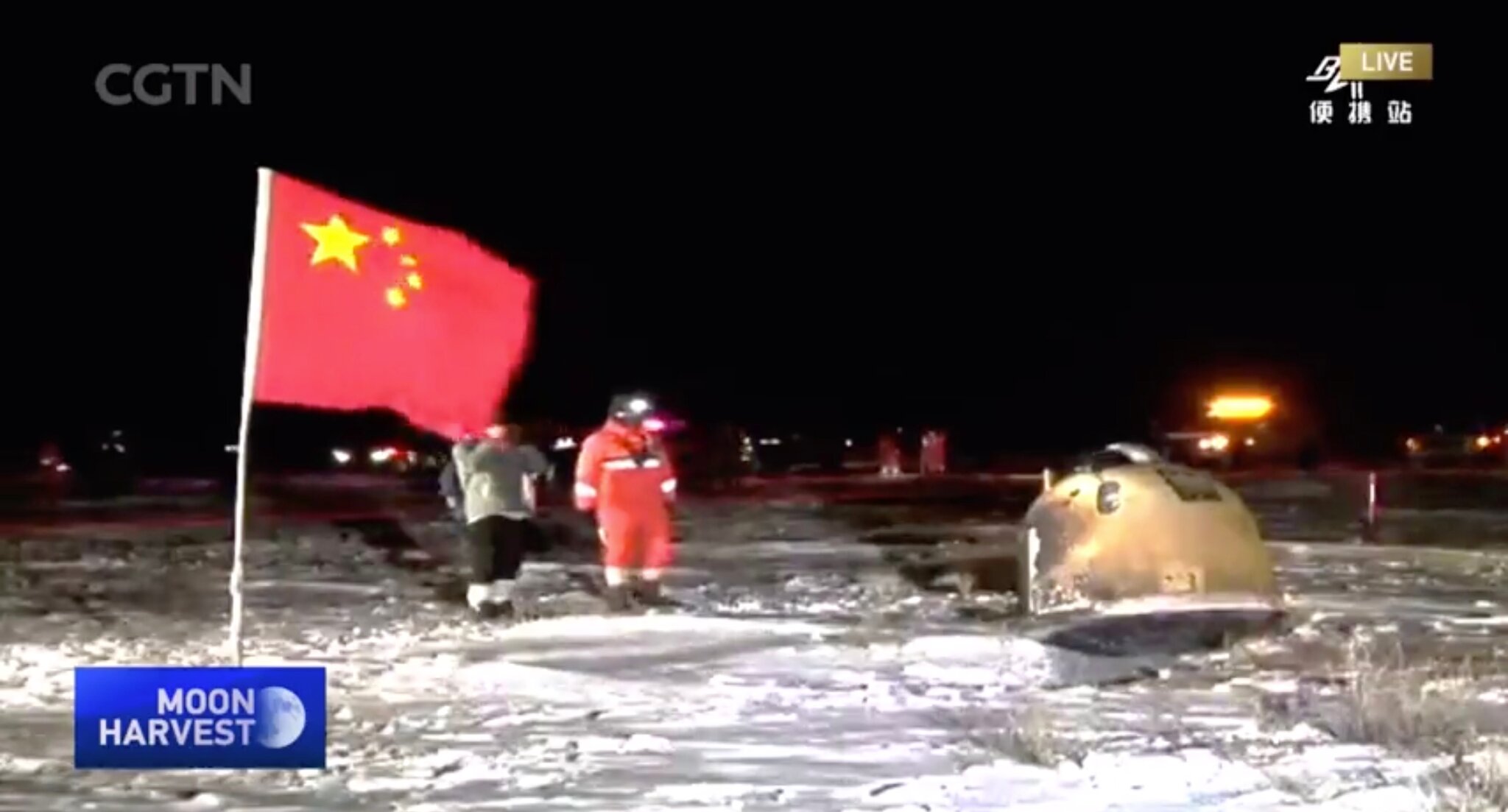
The samples were later transferred to the Earth return capsule, which safely descended and landed in China’s northern Inner Mongolia Autonomous Region. The successful execution of this complex mission raises hopes for the capabilities of China to eventually land humans on the Moon in the next few years.
Perhaps the most useful achievement from this mission is the in the study of volcanic activity on the moon’s far side, which is necessary in the wider understanding of the evolution of not just the moon but our solar system too.
The mission also led to the very first, and successful detection of negatively charged particles on the Moon’s far side. Experts explain that particles are produced when highly energetic solar wind particles slam the Moon’s surface and kick up secondary particles.
It is also inspiring that the instruments that made that detection belonged to European parties under NILS who collaborated with China on the mission, marking Europe’s first such collaboration with China. Lunar exploration is as such a uniting adventure, and we should work to keep it that way, for the long-term unity of humanity.
The China National Space Administration (CNSA) has also hinted on further collaborations with other world countries on space missions with the upcoming Chang’e 7 this year. The orbiter is planned to carry a hyperspectral mineral mapping camera made by Egypt and Bahrain, a 3 kg instrument duo from Thailand to study solar storms and cosmic rays, and a Swiss AED radiation monitor to measure incoming and outgoing radiation to and from Earth. This will also be Egypt, Bahrain, and Thailand’s first missions to study of the Moon. The lander will carry a Russian lunar dust and plasma analyzer, a telescope from the International Lunar Observatory Association, and another retroreflector from Italy-based SCF Lab.
According to China’s plans, after Chang’e 7 helps scientists get a tactile sense of the true nature and accessibility of water ice deposits on the Moon’s south pole, it will launch Chang’e 8 in 2028, comprising a lander, a rover, and an operations robot, to collectively explore the local geology and environment with 14 instruments. The CNSA also aims to test technologies most relevant to sending crew to the Moon at the end of the decade using the Chang’e 8 mission.
China’s crewed Moon landing plan involves building a giant new rocket called Long March 10, capable of sending 27,000 kg of payload on a trajectory to the Moon, tripling China’s current best capacity from the Long March 5, from which the 10 is derived.
Following China’s first crewed Moon landing, estimated to happen in 2030, the country will focus on building the surface phase of the ILRS by 2035. Key to realizing this is a new super-heavy lift and eventually reusable rocket called the Long March 9. The rocket can put 50,000 kg of spacecraft hardware on a Moon-ward trajectory. Once the Long March 9 is operational, China intends to use it to deliver large amounts of cargo — and possibly even more crew — to the ILRS Moonbase. The rocket will deliver critical infrastructure via missions named ILRS 1 through 5, including infrastructure for energy, communications, transportation services (landers, rovers, hoppers, and ascent vehicles), scientific research equipment, and more.
The writer is a senior research fellow, Development Watch Center