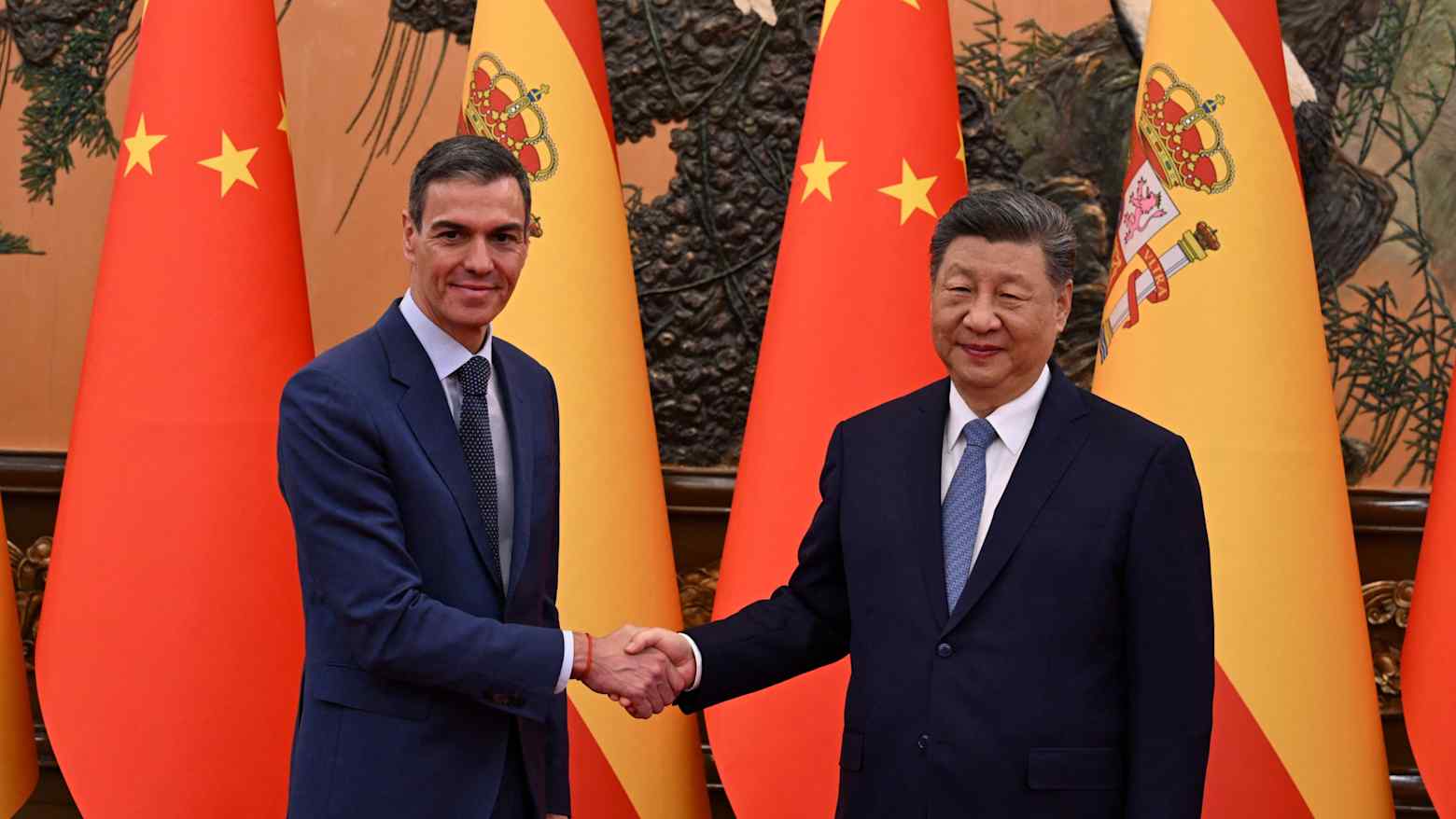
On Sunday April 12th, Spain’s Prime Minister (PM) Pedro Sánchez landed in China for a five days state visit making him the sixth European statesman to do so between December 2025 and April 2026. The leaders coming before him were; Emmanuel Macron of France, Keir Starmer of the United Kingdom (UK), Friedrich Merz of Germany, Petteri Orpo of Finland, and Taoiseach Micheal Martin of the Republic of Ireland. In January, Mark Carney also headed a high level Canadian delegation to China.
In part then, PM Sánchez’s mission can be understood as falling in the emerging trend of European Union (EU) member states opting to collaborate more with Beijing in a bid to hedge themselves against the increased unpredictability in Washington following the re-entry of President Trump on the international political scene. Stopping at that however, would be to miss the most important aspect of Sino-Madrid relations in recent years.
In order to have a better grasp of the dynamics at play, one has to go back to 2023 starting from which, the Spanish Socialist Workers Party’s Secretary General has put it upon himself to embark on an annual diplomatic sojourn to China. This places him in a category of his own. What is even more fascinating is that King Felipe VI and Queen Letizia travelled to the Asian nation too towards the end of last year.
Looking at things from this perspective, the capacities that PM Sánchez’s relationship with Secretary Xi Jinping has brought about overtime become a point of inspiration for other heads of states (both within Europe and outside of it) who are only awakening to the current moment in geopolitics now about the opportunities that become available to harness once a country establishes strong ties with China. A concrete example in this regard is trade between China and Spain which increased by almost 10% in 2025 alone (the final figure stood at $55 billion). Specifically for Madrid, her exports under this bilateral framework grew by 7%.
By working more closely, the two parties have been able to set in place conditions that facilitated the realization of each other’s comparative advantage. In 2024 hence, Prime Minister Sánchez alongside Prime Minister Li Qiang entered agreements on green development, science research, education, culture etc. Two years down the road, Chinese manufacturer Chery announced that it would be setting up a plant targeting to serve the European continent at large in Barcelona.
The Chinese and Spanish political establishments have also been able to provide an alternative model to interstate relations which though cognizant of the fact that national interests can never be aligned across the board, is at the same time sophisticated enough to bypass the same to emphasize areas of common ground. The reigning President of Socialist International addressed this phenomenon in a speech delivered at Tsinghua University during the 2026 official visit saying that; “A multipolar world is not an assumption or an ideal, but a new reality. We cannot change it; we can only deny it or embrace it.”
Unfortunately, when Spain has exemplified this spirit more broadly, her efforts have been treated with contempt. Having denied the United States of America access to the Morón and Rotafor military bases for instance (cautioning instead that “you cannot answer one illegality with another, because that is how the great catastrophes of humanity begin”), the country’s 47th President responded with threats of imposing a full trade embargo on the EU state. The good news is that Donald Trump has not treated less vocal parties kindly either a move that has tested their patience significantly such that as it stands, UK and Paris have both made public the fact that they will not partake in the Strait of Hormuz blockade that America recently announced.
From here, it is not difficult to see them seek to consolidate their cooperation with Beijing given what Spain has managed to achieve by doing so. When he met with President Xi thus, Pedro Sánchez made no secret of the fact that he thought that it was necessary that the China takes a more proactive role in geopolitics and that if the party, it would have the full support of his government.
The writer is a Lawyer and Research Fellow at the Development Watch Centre