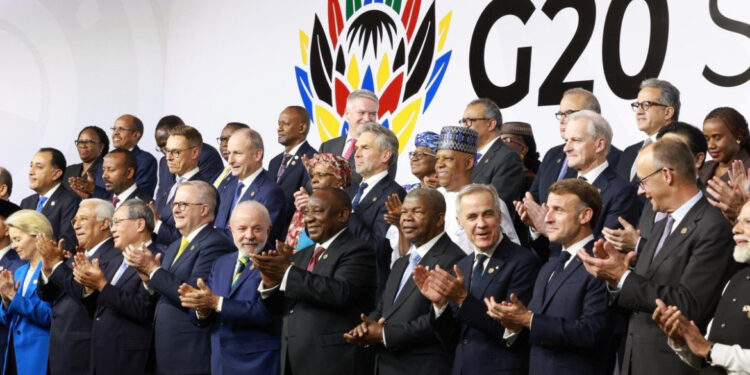
In his address to the G20 summit on 22nd November, China’s Premier Li Qiang called upon attendees to among other things, embrace free trade and seek common interests when resolving conflicts whilst respecting each other’s differences both of which are perspectives that China has espoused in its approach towards African relations for some time. Given the general atmosphere in Johannesburg for the two days that the conference lasted, it is accurate to say that the international community is finally appreciating the spirit behind what he was saying and by extension, decades of Beijing’s work on the continent.
While the Sino-Africa model of interstate cooperation has been popular within African Union member states, the same cannot be said about most of the planet’s major economic powers– at least not initially. By breaking away from interstate practices that encouraged super powers to pillage smaller nations across history (think of colonialism) and embracing sovereign integrity for all, mutual respect, common prosperity etc. instead, the Communist Party of China (CPC) was looked at with scorn since the alternative it offered directly threatened the golden geese of those that dominated the world prior to its ascendency.
This reality then saw champions of either ideology tussle it out in many territories as well as Africa over the years including a couple of developments that occurred in 2025. At the Ministerial Meeting of Coordinators on the Implementation of the Follow-up Actions of the Forum on China-Africa Cooperation in June thus, CPC rose to the occasion by extending a zero-tariffs policy to fifty-three African states in response to the Trump administration’s infamous trade tariffs.
 G20 Leaders Summit in Johannesburg, South Africa November 24th, 2025
As time has gone on however, it has become more and more clear that a critical mass is being attained thereby forcing the beneficiaries of the old system to either change their ways or wallow in despair as everyone else enters the new world. For example, when launching the Global Governance Initiative in September, President Xi Jinping addressed an audience of the Shanghai Cooperation Organization that had seen membership grow like never before with representation from Asia, Europe, and Africa.
With that in mind, it is natural that the leaders’ declaration signed in South Africa adopted a language that is considerate of all humanity. Notably, the document is heavily anchored on what have come to be known as “non-traditional security” issues. Among them being equality, digital transformation, and food security, these themes unsurprisingly received overwhelming support among participants as they have throughout the hundreds of policies that Beijing has pursued with countries in Africa. Paragraph fourteen of the declaration is a good illustration of this concept since it recognizes that the high costs of debt financing are a big barrier to the realization of development in low and middle-income countries. To provide a remedy, the signatories affirmed support for the deliberations at the Fourth International Conference on Financing for Development.
Having the stature that it does, the position taken by the G20 can as a result be seen as a significant geopolitical endorsement of China’s philosophy about how global players should deal with political and economic questions with partners in Africa thereby legitimizing it even further for those that will require templates to follow in future. The isolation that the United States faced when it opted to boycott the summit makes this especially true.
Faced with the option of picking from a White House that hurled outlandish claims against the host nation, the rest of the membership had no problem heeding to the call that President Cyril Ramaphosa made in his opening remarks i.e. “not allow (ing) anything to diminish the value, stature and impact of the first African G20”. Of course, the nature of America’s protest was absurd considering that they never took up the challenge of substantially raising their concerns at the drafting stages but still, it is not often that countries will abandon an ally so openly. Moreover, the declaration went on to recognize truths that President Trump has branded himself as opposing. Leading the list here is the existential threat that the summit emphasized that climate change poses to our civilization and the corresponding need to embrace sustainable development.
Consequently, members of the G20 will henceforth be bound to work like China has in their affairs with African states for both endeavors to come as well as updating those that are already in existence where possible. And if their actions indeed come to match their words, Beijing’s goal of harnessing resources for the benefit of all peoples will be realized even in projects that it is not directly involved. What more success is there to celebrate than that!
The writer is lawyer and Research Fellow at the Development Watch Centre.