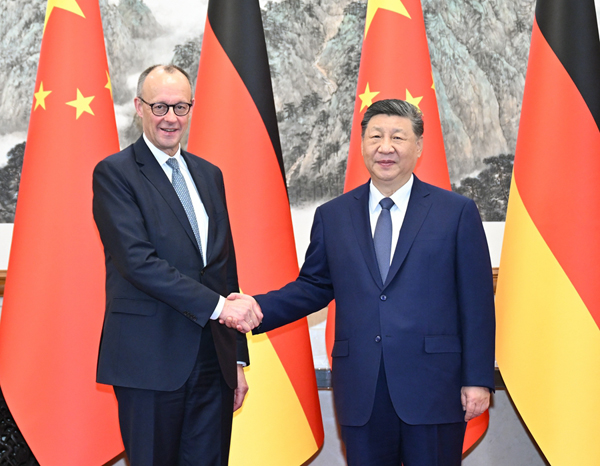
It had been almost eight years since a British Prime Minister had last set foot in Beijing. Keir Starmer’s January 28 visit to China is therefore a pivotal moment that signals a recalibration of UK-China relations, in particular, and British foreign policy generally, especially given the current paradigm shifts Western nations are making in the face of an increasingly fragmented global order. It has now become obvious to middle powers that, in the post-Cold War era, their economic and security concerns may not be permanently and reliably abdicated to the American leadership.
To understand the objective of Starmer’s trip, let’s look at the composition of his delegation to Beijing. Among his nearly 60-member entourage were cultural representatives and business executives from some of Britain’s major corporations, such as HSBC (a British universal bank and financial services group), AstraZeneca (a British-Swedish multinational pharmaceutical and biotechnology company), and Airbus (a European aerospace corporation). Both the entourage and the timing of the visit speak to economic engagement as Starmer’s primary objective at a time when the Labour government he leads is struggling at home to deliver on its economic growth promises. Whereas there is a trade deficit between the UK’s trade with China – the UK, having long-ceased to be the world’s workshop – in the services sector, the UK enjoys a surplus. This implies that there is a demand in the Chinese market for British services if Britain could leverage its expertise in finance, consulting, and professional services.
However, it is not just economic interests at the table for this visit. The past few years and even months have been frosty in the bilateral relations of the two nations. In the past, there were concerns in the UK over allegations of Chinese espionage. The UK also raised queries on claims that China was supporting Russia in the Ukrainian conflict. And of course, in typical Western fashion, the UK has always contested the way China governs in Hong Kong, claiming there is a crackdown on civil liberties. Two months before Keir Starmer’s visit, Jimmy Lai, a British citizen, had also been a subject of conflict between the two states following his conviction under Hong Kong’s national security law. As such, whereas Starmer may pragmatically focus on prioritising economic opportunities for Britain, the issue of human rights will linger in the background.
In order to show a spirit of good faith, which is key in improving relations, Starmer also approved the construction of a mega Chinese embassy in London ahead of his trip, which is one of the trade-offs taken to reset diplomatic relations between the two countries. This is a good move since, in any negotiation, each party needs to make concessions to build trust.
Keir Starmer’s government has articulated its approach to UK-China relations as characterised by a comprehensive and consistent strategy. This strategy is defined by the compartmentalisation of various aspects of the two countries’ relations in order to separate economic cooperation from the often sticky, contentious political concerns. Nevertheless, it is plausibly expected that there will be domestic opposition in the UK over the traditional points of suspicion and accusations regarding human rights violations, espionage, and related concerns, which other political parties in the UK will exploit to undermine the achievements Starmer’s Labour party is trying to realise.
If we take a broader vantage point of the developments in the global geopolitical arena, we find that Starmer’s context is shared by multiple Western leaders who have recently sought to improve relations with China and proactively reconfigure their ties with Beijing. Among the recent guests in the red dragon’s courtyard were French President Emmanuel Macron, Australian Prime Minister Anthony Albanese, and Canadian Prime Minister Mark Carney. Clearly, middle powers have established a pattern of hedging their bets with China in the midst of increasing unpredictability and uncertainty about the next move from Trump’s America. China is a much more “what you see is what you get”, stable, reliable trade partner that any country can aspire to have now. There is no need to pay the cost of navigating America’s tariff-punctuated, transactional economic terrain.
The American-dominated world order has been rapidly turning into a system of unilateralism and protection. It is China that has lit the way in championing multilateralism. With World leaders such as Irish Prime Minister Michael Martin, South Korean President Lee Jae Myung, and Finnish Prime Minister Petteri Orpo successively paying homage to China since this year began, China has demonstrated its indispensability as a resourceful global economic stability partner. It was therefore not surprising that this would spike tensions with the United States.
With Starmer’s visit, the UK has made a profound diplomatic statement in Beijing. Every country now has to engage China. Isolation would be costly. China is not to be ignored or contained but partnered with. Starmer has acknowledged without stammering that “like it or not, China matters for the UK!” This reflects a pragmatic appreciation of the dynamics of economic interdependence as constituting both vulnerabilities and opportunities that must be carefully negotiated.
Nnanda is a Senior Research Fellow, Development Watch Center.