Luiz Inácio Lula da Silva’s recent fourth non-consecutive term win as Brazil’s president is a significant milestone not just for Brazil but also for the future of BRICS. In Lula’s win, I believe that Brazil has secured its place in the BRICS bloc, which his main opponent, Bolsonaro, threatened, and the strategic autonomy of developing countries is also protected.
Whereas Lula has now secured his legitimate mandate to preside over Brazil, the constraints he faced are noteworthy. He was led in the first round by Flávio Bolsonaro’s right-wing Liberal Party (PL) by 47% to 45%. With allied conservative and centre-right parties, Bolsonaro’s right-wing coalition commands an absolute majority in the legislature. Despite the historic legislative victory the right had in the election, and its first-round lead, President Lula managed a dramatic comeback in the runoff, winning the presidency with 51.79% of the vote.
It is likely that BRICS would survive even if one of the major capitals left the bloc, because it has multiple members with rotational chairs. Brazil chaired it in 2025 and hosted the Rio Summit, while India took over in January 2026 and China is due to take over in 2027. Therefore, had Brazil exited the bloc under a different leader, it would not collapse the institution, although Brasilia’s political weight would be lost. That weight cannot be overstated. Brazil is Latin America’s largest BRICS member. It has a long history of non-alignment. It also, together with India, curbed the bias against BRICS being an anti-Western club.
BRICS’ future with Lula’s win gets a stark contrast when compared to a counterfactual of Bolsonaro’s win. His program was keener about building closer ties with the United States, Israel and Argentina. He was also very critical of the BRICS bloc’s promotion of trade that bypassed the dollar, although he promised to pragmatically work with China without automatically siding with Beijing or Washington. There was also fear that Brazil could leave BRICS under a Bolsonaro government, something he himself indicated in his campaigns during the 2026 presidential elections. Even if he didn’t do that, it is likely that his presidency would have downgraded BRICS and reduced its priority and attention. Now with Lula’s victory, that uncertainty is removed, and Brazil is cemented as an active bloc member.
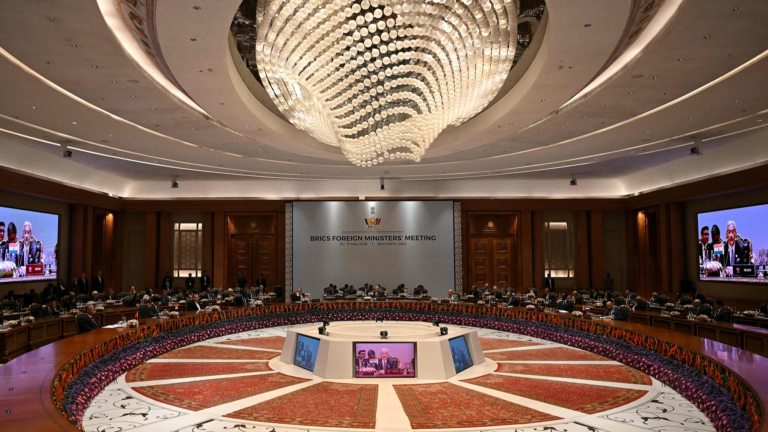
During the 18th BRICS summit hosted by India in September this year in New Delhi, the summit produced a consensus outcome document, the “New Delhi Declaration.” While there was no mention of “de-dollarisation”, and no reference to a BRICS common currency, member states did back intra-group commerce carried out in local currencies. The summit also discussed the settlement of trade and investment deals in members’ own currencies, while stressing national priorities and accepting that no single approach suits everyone. Brazil has had a pragmatic position on this issue for a while. In the Southern Common Market, it has argued for a dollar-free settlement since 2023, and it also agreed to trade with China directly in the yuan. BRICS members may not move suddenly to de-dollarize, but there is a gradualist agenda to break the weaponizable dollar system. And Lula’s win represents continuity in the gradualist agenda, not a dramatic break.
Upon his election victory, President Lula made it clear that “Brazil will not accept being anyone’s backyard.” Of course, this message was aimed at the ears in Washington. Lula skilfully used foreign policy as a tool in this election, something rare in politics, as domestic elections are usually not won on foreign policy per se.
But it matters. And several countries in Latin America had swung to the right, with Ecuador, Chile, Colombia, Argentina and Peru all electing presidents whose alignment with the trump regime was intimate. It is only obvious that Trump would have wished to have Brazil, Latin America’s largest economy, with the largest reserves of rare earth minerals after China, as part of America’s backyard in the Western Hemisphere.
Now with Lula’s victory cemented, the BRICS alliance and the Global South as a whole are refreshed in the hope of gaining a greater stake on the world stage. His victory provides reassurance of the strength and stability of the bloc, which Trump has said is a threat to US interests and a stumbling block in his path to reassert US power across the globe. Brazil’s commitment to BRICS would likely have been compromised had Flavio Bolsonaro won.
The writer is a senior research fellow at the Development Watch Centre