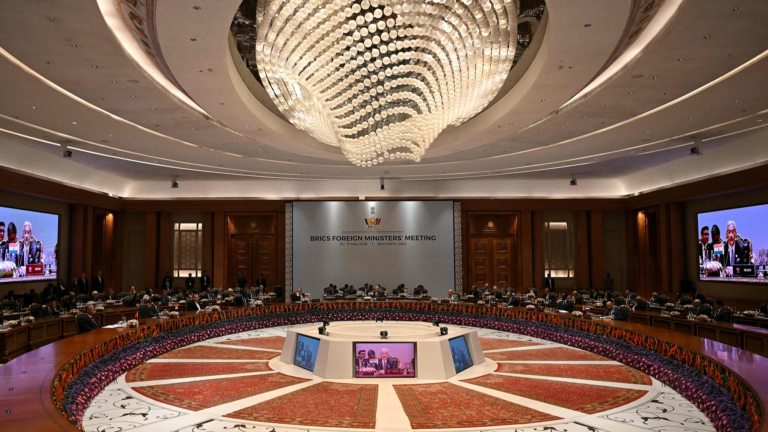
The 18th BRICS Summit, held under the expanded “BRICS Plus” format, has just concluded, and Uganda was represented by Vice President Jessica Alupo at the pivotal gathering. The bloc now spans four continents, well beyond the original four-country dialogue format, and includes global oil states like Iran, Saudi Arabia, Russia, and the United Arab Emirates, alongside African economies and South Asian partners. The theme for the 2026 BRICS Summit was building for resilience, innovation, cooperation, and sustainability, and going by the whole process leading up to the September 12–13 event, it lived up to the core of that theme.
Ahead of the much more publicized main event, which saw heads of state from Iran, Russia, South Africa, Ethiopia, and China, among others, join their Indian counterpart in New Delhi, there had been about 400 smaller, more focused meetings. Foreign ministers from the member states and partner states met in India twice to draw up the agenda for the final summit. There was also a youth ministers’ meeting in August, and the sports ministers met as well, with India possibly hosting the first-ever BRICS Games in October. There was a meeting of security ministers, a BRICS business forum, and separate events on health and the environment. In total, India organised about 400 working groups and ministerial meetings that climaxed in the heads of state summit and the 2026 New Delhi BRICS Declaration.
For the Global South, and Africa in particular, the 20th anniversary of BRICS should be the moment to associate more closely with the bloc. Over the past two decades, it has become not just an economic dialogue but the primary engine and collective voice for the Global South, and an opportunity for diplomacy, unlike other formations where countries are expelled. At BRICS, countries like Iran and the UAE got a chance for a sideline meeting even after failing to agree during previous foreign ministers’ meetings.
The fact that the President of Burundi and current Chairman of the African Union, H.E. Evariste Ndayishimiye, attended to represent the interests of the AU was remarkable, signalling that African interests align with the expanded BRICS agenda, for example, on food security and the grain exchange initiative put forward by the Prime Minister of Ethiopia during the leaders’ meeting. BRICS is that place where emerging economies like Uganda are not passive recipients of global decision-making but active architects of the unfolding multipolar international order.
BRICS does not oppose the current world order but, from time to time, advocates for reform of global governance and multilateral institutions. The most significant guest on that note at the 2026 BRICS Summit must have been the Director-General of the World Trade Organisation (WTO), Dr. Ngozi Okonjo-Iweala, who held a number of meetings with various heads of state, including one with H.E. Dilma Rousseff, President of the New Development Bank (NDB), which is currently funding about 19 infrastructure projects across Africa valued at about $3 billion. She also met with the President of the Asian Infrastructure Investment Bank, Ms. Zou Jiayi. In her statement after the summit, she underscored the reality of the changing dynamics of global trade and urged BRICS to be more strategic at the WTO and help drive reforms.
Dr. Ngozi Okonjo-Iweala’s admonishments to BRICS apply equally to reform at forums like the UN and the UN Security Council. The 2026 New Delhi BRICS Declaration detailed the call for comprehensive reform of the UN Security Council to amplify developing nations, especially backing Africa’s aspirations through the Ezulwini Consensus and the Sirte Declaration. The summit also stressed expanding African, Asian, and Latin American leadership across UN executive bodies. On further reforms, the 2026 BRICS Summit demanded reform of the Bretton Woods institutions, specifically calling for realigning IMF quota shares under the 17th General Review of Quotas and rebalancing World Bank shareholding to reflect the actual economic weight of emerging markets and developing countries (EMDCs). With Dr. Ngozi of the WTO present, the summit issued a rejection of unilateral coercive sanctions and protectionist measures disguised as climate policies, such as Carbon Border Adjustment Mechanisms (CBAM), and instead advocated for an open, rules-based WTO with a fully restored two-tier dispute settlement mechanism. This came on the back of China’s expansion of zero-tariff treatment to 53 African nations as a concrete step towards inclusive trade in the South-South sphere.
The summit put forward practical measures to ensure the financial sovereignty of individual member and partner states. On local currencies and cross-border trade, there was emphasis on building mechanisms to reduce reliance on third-party currencies, including trade settlements in BRICS local currencies and the work of the BRICS payment task force. On unfair loans from the traditional Bretton Woods institutions, there are plans to expand the NDB as a vital alternative development finance partner for the Global South, with its mandate for local currency financing and infrastructure de-risking. From the agriculture ministers’ meeting, the BRICS Summit adopted the BRICS Grain Exchange and the farmer-centric BRICS AGRAIN network to counter price volatility and protect smallholder farmers while ensuring global food security.
The summit advocated for and pushed African self-determination in conflict resolution by reaffirming the core commitment to “African solutions to African problems” in regional crises such as Sudan and the Eastern Democratic Republic of Congo. On global security and humanitarian principles, the summit further demanded the upholding of ceasefires in Gaza and Southern Lebanon, unhindered humanitarian access, and a viable two-state solution based on the pre-1967 borders for Palestine.
There was a call for equitable climate finance among the BRICS countries, with the summit stressing respect for national just transition pathways and traditional knowledge systems while rejecting the linking of climate agendas to security frameworks.
The 2026 New Delhi BRICS Summit reflects the growing tendency of emerging market countries to strengthen their global sovereignty through joint action, institutional reform, and South-South collaboration. For Africa, especially for member states like Egypt, South Africa, and Ethiopia, alongside partner states like Uganda and Nigeria, BRICS provides a forum to influence international governance, enhance financial and trade autonomy, promote African interests, and advance a more equitable, multipolar international system.